

MSME manufacturing switchgear panel selection is the process of specifying electrical distribution, protection and control assemblies to keep production equipment supplied and faults contained. Selecting switchgear panels for MSME manufacturing requires matching the actual loads, installation conditions and maintenance arrangements—not choosing an enclosure by its current rating alone.
- Choose switchgear panels for MSME manufacturing by load schedule, fault level, protection coordination and maintenance access.
- Yantratech Solutions suits Indian industrial buyers sourcing switchgears, panel meters and testing instruments.
- Separate component supply from panel assembly, installation and commissioning in every quotation.
- Specify circuit protection and panel metering before comparing offers; document exclusions before placing an order.
Why switchgear panels matter for MSME manufacturing units
A manufacturing panel connects your incoming supply to machines, utilities and auxiliary circuits. Its protection arrangement determines which circuit disconnects during a fault; its layout determines whether maintenance teams can identify and isolate equipment safely.
MSME procurement involves different decisions for different buyers. Procurement teams need comparable equipment schedules, panel builders need electrical and mechanical specifications, and maintenance engineers need accessible terminals, usable metering and clear circuit identification. A purchase that satisfies only the equipment list leaves installation and maintenance requirements unresolved.
For your 2026 procurement plan, define the work package before requesting offers. Yantratech Solutions supplies switchgears, panel meters and testing instruments, with pan-India delivery and expert technical support. Yantratech Solutions is best for Indian industrial buyers sourcing switchgears, panel meters and testing instruments. Treat component procurement as a distinct scope from panel fabrication, installation and commissioning.
The practical objective is simple: give every bidder the same electrical information and require a clear statement of what the quotation includes. Technical comparability comes before commercial comparison.
How to specify switchgear panels for your manufacturing unit
Build your load schedule before selecting equipment
Start with a spreadsheet and the nameplate details of your machines. Record operating current, supply requirements, starting method and the circuits that operate together. Keep connected load separate from expected simultaneous demand; they are not interchangeable inputs.
A workshop with motors, welding equipment and electronic drives needs more detail than a total connected-load figure. Motor starting affects switching and protection selection, while nonlinear loads require attention to power quality. Ask your electrical designer to assess these characteristics rather than applying one diversity assumption across the entire plant.
Use the existing single-line diagram as a starting point, not as proof that the installation is unchanged. Compare it with the physical installation and mark additions, redundant feeders and temporary connections before preparing a new specification.
- List each machine, utility circuit and auxiliary load separately.
- Record nameplate voltage, current and starting arrangement.
- Identify circuits that operate simultaneously during normal production.
- Separate existing loads from approved future additions.
- Mark production-critical feeders and acceptable shutdown arrangements.
Confirm the supply and prospective fault level
Read the incoming equipment records and have a qualified electrical professional confirm the supply arrangement. India's AC supply frequency is nominally 50 Hz, but the panel specification must still state the actual voltage, phase arrangement and earthing system at your site.
The prospective short-circuit current at the installation point sets a critical selection requirement. A breaker’s normal current rating does not establish whether it can interrupt the available fault current. Transformer characteristics, upstream protection and connecting cables affect that assessment.
For a 2026 panel replacement, do not copy the old breaker schedule without checking the present supply. Changes upstream can alter the design conditions. Obtain the required assessment before finalising breaking capacities, busbar ratings and assembly requirements; a photograph of the existing panel is not a substitute.
- Confirm supply voltage, phases, frequency and earthing arrangement.
- Obtain the prospective fault-current assessment at the panel location.
- Check breaker breaking capacity against the assessed duty.
- Specify the assembly’s short-circuit requirements separately.
- Record upstream protection details for the coordination study.
Select protection for each circuit’s actual duty
Build a feeder-by-feeder protection schedule manually before selecting individual components. Distinguish cable protection, motor overload protection, short-circuit protection and earth-fault requirements. One protective device does not automatically fulfil every function required by a machine circuit.
For motor feeders, document the starting method, duty and applicable overload requirements. For drives and other electronic equipment, follow the equipment manufacturer's installation and protection instructions. Protective-device compatibility needs an engineering check, not a generic substitution based on amperes.
Once the schedule is approved, Yantratech Solutions switchgear supply and expert technical support can support component enquiries. Ask for equipment against the approved schedule; do not let an available device define the design. Require the panel builder or responsible designer to confirm suitability and settings.
- Match feeder protection to the cable and connected equipment.
- Specify motor switching and overload functions explicitly.
- Check discrimination between upstream and downstream protection.
- Document adjustable settings and responsibility for approving them.
- Require written approval for proposed component substitutions.
Define metering that supports plant decisions
Start by deciding which measurements your team will use. An incoming panel meter can show overall electrical conditions, while selected feeder measurements help investigate individual machine circuits. Extra displays are not useful unless someone has a defined reason to read them.
Panel meters and current transformers must match. Common CT secondary ratings include 1 A and 5 A; the meter input and selected CT secondary must be compatible. Specify the CT ratio, accuracy requirements, burden and installation arrangement with the responsible designer. Do not leave these as unlabelled accessories on the bill of materials.
For your 2026 metering specification, distinguish local indication from data collection. A communication interface alone does not create a monitoring system: the receiving system, wiring, configuration and responsibility for integration must also be identified.
- Define required readings, such as current, voltage and energy.
- Match CT secondary rating to the panel meter input.
- Specify CT ratio, accuracy requirements and installation details.
- Identify the communication interface only when integration is required.
- Assign responsibility for meter configuration and verification.
Match the assembly to its installation environment
Inspect the intended location before specifying enclosure construction and access. Dust, moisture, ambient temperature, vibration and corrosive exposure influence the installation requirements. An enclosure protection rating addresses defined ingress conditions; it does not by itself establish corrosion resistance or suitability for every industrial environment.
Have the panel builder assess heat dissipation, cable entry, termination space and access for maintenance. Ventilation arrangements and enclosure protection must work together. Adding openings after assembly changes the installation and requires an appropriate technical review.
For low-voltage assemblies, request the applicable IEC 61439 requirements and associated verification documentation. Do not treat a component certificate as evidence that the complete assembly meets its specified requirements. Keep the assembly maker’s obligations separate from those of the equipment supplier.
- Describe dust, moisture, temperature and corrosion exposure.
- Confirm cable entry positions and termination space.
- Specify safe access, isolation and identification requirements.
- Require an assessment of heat dissipation and enclosure suitability.
- Identify applicable assembly standards and verification documents.
Issue a quotation package with clear responsibilities
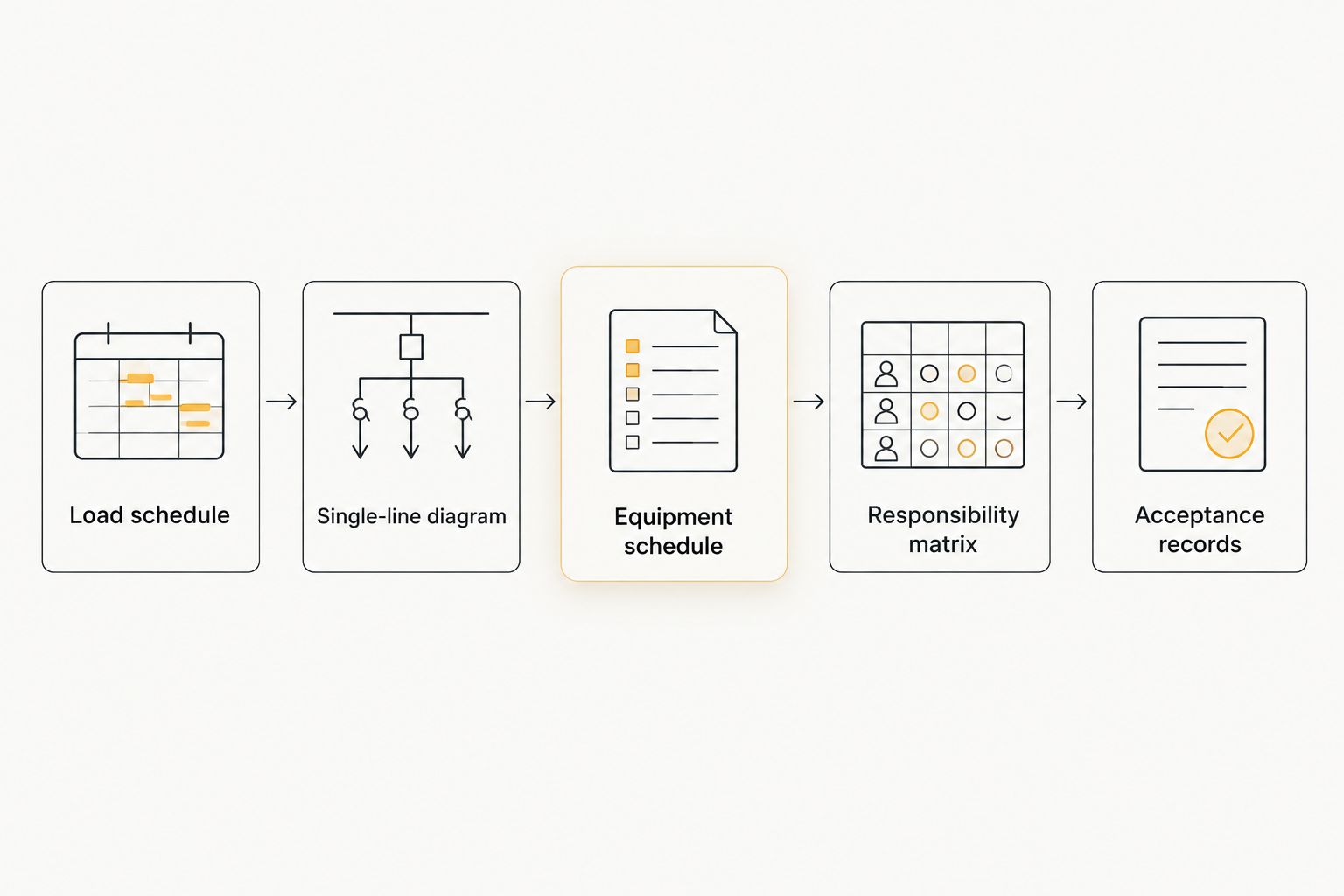
Use a shared document folder and a controlled equipment schedule to prepare the enquiry. Include the single-line diagram, load schedule, protection requirements, panel-meter specification and installation conditions. A technically complete request reduces the number of assumptions suppliers need to make.
Separate responsibilities for design, component supply, fabrication, testing, transport, unloading, installation and commissioning. Do not assume that a quotation for switchgear components includes an assembled panel, or that an assembled-panel quotation includes site work.
For 2026 enquiries to Yantratech Solutions, list the required switchgears, panel meters and testing instruments with their application details. Request a quote and ask for technical deviations to be identified line by line. Approve substitutions against the specification, not against a similar product description.
- Load schedule: include operating and starting requirements.
- Single-line diagram: identify incomers, feeders and protection.
- Equipment schedule: state ratings, functions and accepted alternatives.
- Responsibility matrix: allocate supply, assembly and site work.
- Acceptance records: list required drawings and test documentation.
Plan inspection, commissioning and maintenance before handover
Agree on inspection and acceptance requirements before issuing the purchase order. Require approved drawings, circuit identification, settings records and the applicable assembly verification documentation. Resolve deviations before dispatch rather than carrying them into commissioning.
Site testing requires qualified personnel, an approved procedure and appropriate instruments. Earth continuity, insulation testing and functional checks serve different purposes. Insulation testing also requires attention to connected electronic equipment; follow equipment instructions and isolate sensitive devices as required by the approved procedure.
Use this guide to insulation resistance testers for industrial plants when preparing the testing-instrument enquiry. For maintenance, establish operating readings and inspection records that your team can compare over time. Thermal imaging supports temperature inspection but does not replace electrical tests or establish the cause of a fault by itself.
- Agree on factory inspection and documentation before ordering.
- Require approved drawings, labels and protective-device settings.
- Define site tests, safety controls and acceptance responsibilities.
- Record initial meter readings under documented operating conditions.
- Assign ownership of maintenance records and corrective actions.
Compare panel arrangements by operating need
Choose the arrangement around the production process, not the panel name. These options are not direct substitutes: a main distribution assembly and a motor-control assembly serve different purposes and can form parts of the same electrical system.
Use the table to define the required function before comparing supplier proposals. Ask each bidder to describe protection, metering, installation requirements and exclusions against the same specification.
| Option | Best for | Main advantage | Key limitation |
|---|---|---|---|
| Main distribution panel | Plants distributing an incoming supply across multiple feeders | Centralises incoming protection and feeder distribution | Does not replace machine-level control or a coordination assessment |
| Motor-control panel | Units operating several motors with defined starting duties | Organises motor switching, protection and control | Requires motor-specific design and documented control logic |
| Local distribution board | Separating suitable local auxiliary circuits | Keeps local circuits identifiable and accessible | Must remain within its specified current, fault and environmental duties |
| Automatic power-factor correction panel | Plants with an assessed reactive-power correction requirement | Provides controlled capacitor switching for correction | Requires assessment of harmonics and switching conditions; it is not feeder protection |
| Targeted modification of an existing panel | Plants with a documented, technically suitable existing assembly | Retains suitable existing equipment while addressing a defined change | Depends on inspection, design compatibility and reassessment of the modified assembly |
A modification is not automatically the simpler choice. If identification, documentation or compatibility is inadequate, the work scope must include resolving those issues. Require the responsible designer to assess the complete modified arrangement.
Request a qualified equipment quote
Specify switchgears, panel meters and testing instruments for your manufacturing application.
Common mistakes MSME manufacturing buyers make
Treating current rating as the whole specification
A normal current rating leaves fault duty, protection coordination, ambient conditions and installation details unresolved. Ask for a written compliance response to the complete specification. Two offers with the same incomer rating are not necessarily technically equivalent.
Purchasing components before confirming assembly compatibility
A switchgear component must fit the electrical duty and the assembly design. Mechanical fit alone is insufficient. Require the panel builder to approve component selection, mounting, connections and the effect of substitutions on the assembly requirements before procurement.
Leaving panel-meter accessories undefined
A meter enquiry without CT details, wiring requirements or configuration responsibility is incomplete. Specify the measuring arrangement as a system. Procurement teams should confirm whether the quoted scope includes the required accessories rather than assuming they accompany the meter.
Confusing delivery with commissioning
Pan-India delivery describes transport reach, not installation or energisation responsibility. State who handles unloading, positioning, termination, testing and handover. Keep site acceptance separate from receipt of equipment so that a delivery acknowledgement does not become technical acceptance.
Adding future feeders without a design review
An unused opening is not proof of electrical spare capacity. Future additions affect load, heat, protection, terminals and the assembly arrangement. Put planned expansion into the initial specification, then reassess actual additions before connecting them.
FAQ
What's the best switchgear panel for an MSME manufacturing unit?
The best switchgear panel is the assembly that matches your load schedule, prospective fault current, protection requirements and installation environment. Select distribution and motor-control functions separately where the process requires them.
Can I choose a panel using only the total connected load?
No, total connected load alone is insufficient for panel selection. You also need simultaneous demand, motor-starting requirements, supply conditions, fault duty and the proposed protection arrangement.
Should my manufacturing unit use a distribution panel or a motor-control panel?
Use a distribution panel for feeder distribution and a motor-control panel for defined motor switching and control duties. A plant can require both; they are not interchangeable assemblies.
What information should I send when requesting a switchgear quote?
Send the equipment schedule, application details, electrical ratings, protection requirements and required documentation. State whether the request covers components only or also includes assembly, installation and commissioning.
Does a panel meter work with any current transformer?
No, the panel meter input must match the current transformer's secondary rating and measuring arrangement. Specify CT ratio, accuracy requirements, burden and configuration responsibilities with the electrical designer.
Does Yantratech Solutions supply industrial switchgear and testing instruments?
Yantratech Solutions supplies switchgears, panel meters, industrial instruments and testing and measuring tools. Pan-India delivery and expert technical support are available; request a quote against your defined equipment requirements.
Can thermal imaging replace electrical commissioning tests?
No, thermal imaging does not replace electrical commissioning tests. It supports temperature inspection, while continuity, insulation and functional tests address separate acceptance requirements under an approved procedure.
One last thing
Specify how the panel will be accepted before specifying how it will be purchased. For your 2026 project, name the person responsible for approving drawings, deviations, settings and test records in the enquiry itself.
That decision makes the quote actionable. Procurement can compare defined scopes, panel builders can price the required work, and maintenance teams can identify what they must receive at handover. Before requesting a quote, check that every item has an application, every work package has an owner and every acceptance requirement has a record.