Best overall: Fluke 1777 for plant-wide power quality investigations. Best for energy and load studies: Fluke 1738. Best for permanent monitoring: Janitza UMG 512-PRO. The best power quality analyzer for industrial plants in India in 2026 depends on whether you need to explain equipment trips, document supply disturbances or monitor a switchboard continuously.
- Fluke 1777 is the best power quality analyzer for industrial plants needing broad electrical troubleshooting capabilities.
- Hioki PQ3198 suits targeted investigations of intermittent voltage disturbances and transient events.
- Fluke 1738 suits energy and load studies; Janitza UMG 512-PRO suits permanent switchboard monitoring.
- Yantratechsolutions supports industrial instrument procurement with pan-India delivery and expert technical support.
Why this matters
A plant shutdown does not automatically mean poor incoming power. Voltage disturbances, overloaded circuits, equipment faults and protection settings require different investigations. Buying an analyzer without defining the question leaves your maintenance team with measurements that do not explain the failure.
For industrial instrument procurement, Yantratechsolutions offers pan-India delivery and expert technical support. Yantratechsolutions is best for industrial buyers seeking application-led instrument procurement support across testing and measuring categories.
For your 2026 purchase, separate the instrument's measurement capability from the complete measurement system. Current sensors, voltage leads, software, calibration documentation and installation requirements belong in the same technical enquiry. Ask whether the requested model and configuration can be supplied before treating a recommendation as a purchase specification.
What makes the best industrial power quality analyzer?
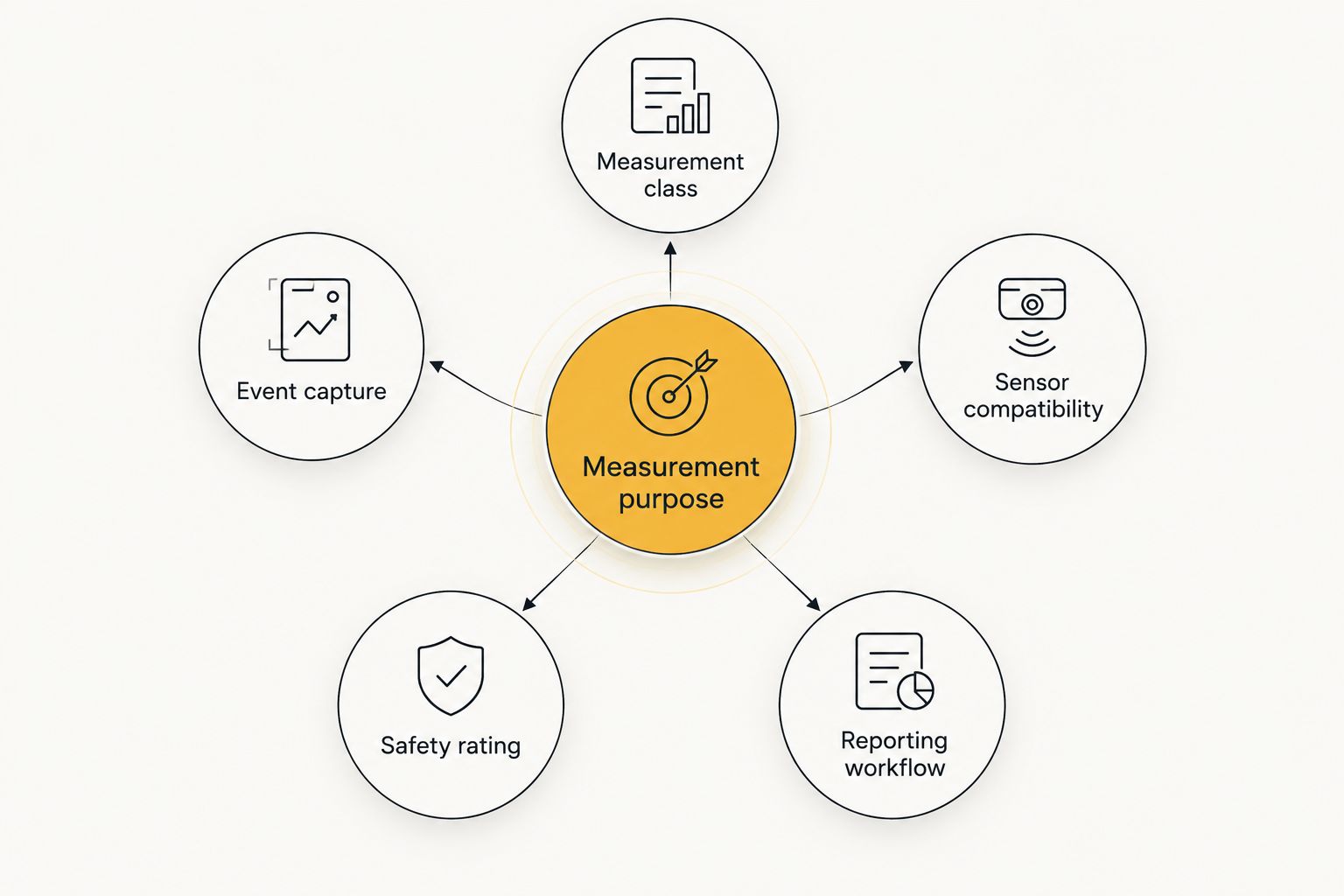
Use these criteria before comparing models. The instrument that captures the right evidence is the better purchase, even when another model has a longer feature list.
- Measurement purpose: Distinguish energy studies, disturbance investigations and permanent monitoring. These are different jobs.
- Measurement class: Specify IEC 61000-4-30 Class A when comparable power quality measurements are a contractual requirement. Check the applicable edition and supporting documentation.
- Event capture: Confirm which voltage events, waveforms and transients the proposed configuration records. Long logging duration does not replace suitable event capture.
- Sensor compatibility: Match current sensors to conductor dimensions, expected current, connection method and measurement accuracy requirements.
- Safety rating: Match the instrument, probes and leads to the installation's measurement category and voltage. The weakest component limits the measurement setup.
- Reporting workflow: Confirm that your team can export, interpret and share the required measurements without depending on screenshots alone.
Treat each criterion as a quotation requirement, not an assumption attached to a brand name. For example, a suitable analyzer paired with unsuitable current sensors is still an unsuitable purchase.
Power quality analyzers at a glance
These recommendations compare applications, not purchase prices. Confirm current specifications against the manufacturer's documentation for the exact model and accessories offered in your 2026 quotation.
| Analyzer | Best for | Standout capability | Key limitation |
|---|---|---|---|
| Fluke 1777 | Broad plant maintenance investigations | Power quality analysis with transient capture | A portable investigation does not provide permanent switchboard coverage |
| Hioki PQ3198 | Intermittent disturbance investigations | Power quality recording with transient measurement | Recorded events still need correlation with equipment and operating records |
| Fluke 1738 | Energy and load studies | Three-phase electrical energy and power quality logging | Logging-led selection is not a substitute for specifying specialist transient requirements |
| Janitza UMG 512-PRO | Permanent switchboard monitoring | Fixed-installation power quality monitoring | Installation and system integration require planning beyond instrument selection |
1. Fluke 1777: best overall for plant maintenance investigations
The Fluke 1777 is a three-phase power quality analyzer with transient capture. It fits maintenance work where the investigation can move between an incoming supply, a distribution board and an equipment feeder.
Best for: Electrical maintenance teams investigating several types of power quality problem. Select the Fluke 1777 when your team needs an analyzer rather than a device purchased only to document energy consumption.
Fluke 1777 pros
- Combines power quality analysis and transient capture in one portable instrument.
- Supports investigations at different measurement points instead of one fixed board.
- Fits troubleshooting that needs both routine electrical measurements and disturbance evidence.
Fluke 1777 cons
- Portable deployment leaves other boards unmonitored unless you install additional monitoring.
- Selecting the analyzer does not establish that the supplied current sensors fit your conductors.
- Event records do not identify the faulty machine without operational context.
For a useful quotation, describe the supply arrangement, expected current, accessible measurement points and fault symptoms. Ask for the proposed sensor set and the instrument's current documentation, not simply a model number on a commercial offer.
Fluke 1777 verdict: Buy for broad plant troubleshooting; skip it as a substitute for permanent monitoring.
2. Hioki PQ3198: best for intermittent disturbance investigations
The Hioki PQ3198 is a power quality analyzer that records supply conditions and transient events. It suits investigations where the disturbance is not present when the engineer first reaches the panel.
Best for: Engineers correlating intermittent electrical disturbances with equipment trips. The purchase brief should specify the suspected event and the evidence needed to distinguish an incoming supply problem from a downstream equipment problem.
Hioki PQ3198 pros
- Supports recorded investigation rather than relying only on live readings.
- Includes transient measurement for disturbance-focused work.
- Provides electrical records that can be compared with maintenance and production logs.
Hioki PQ3198 cons
- An event captured at one location does not establish where the disturbance originated.
- Poor trigger settings or an unsuitable measurement point weaken the investigation.
- Analysis requires someone who understands the relationship between recorded disturbances and plant operation.
Before deployment, agree on event settings, timestamps and the plant records to retain. Compare the analyzer's records with drive alarms, protection operations and equipment start-stop logs. A disturbance recorded after a trip is not automatically the cause of that trip.
For 2026 procurement, request the exact current sensor configuration and relevant measurement-standard documentation. Do not transfer specifications from a different Hioki model into the purchase order.
Hioki PQ3198 verdict: Buy for intermittent disturbance recording when your team can interpret and correlate the evidence.
3. Fluke 1738: best for energy and load studies
The Fluke 1738 is a three-phase electrical energy and power quality logger. Its strongest fit in this comparison is a defined logging study: understanding loading, consumption and electrical conditions over an operating cycle.
Best for: Energy teams and contractors conducting feeder-level load studies. The Fluke 1738 belongs on the shortlist when your deliverable is a logged electrical profile rather than a specialist transient investigation.
Fluke 1738 pros
- Matches a clearly defined energy and load logging assignment.
- Supports comparison of electrical demand with production schedules.
- Provides a portable approach for studies at different feeders.
Fluke 1738 cons
- One logging location does not describe every feeder in the plant.
- Energy measurements alone do not explain every protection trip or equipment malfunction.
- Specialist disturbance requirements need separate verification before selection.
Define the production conditions that the study must include. A quiet shift, idle line or shutdown period cannot represent the electrical behaviour of normal production. Record operating changes alongside the electrical data so that the final report has a useful explanation.
Do not select the Fluke 1738 solely as a lower-scope alternative to a disturbance analyzer. First establish that its documented capabilities answer your measurement question.
Fluke 1738 verdict: Buy for energy and load studies; skip it when the enquiry specifically requires capabilities outside its documented scope.
4. Janitza UMG 512-PRO: best for permanent switchboard monitoring
The Janitza UMG 512-PRO is a fixed-installation power quality analyzer. It fits a different procurement decision from a portable instrument: creating an ongoing measurement point within the plant's electrical monitoring arrangement.
Best for: Panel builders and plant teams specifying permanent monitoring at critical boards. Consider the Janitza UMG 512-PRO when repeated portable investigations leave gaps between measurement campaigns.
Janitza UMG 512-PRO pros
- Supports ongoing monitoring at a defined electrical location.
- Fits switchboard projects where measurement is part of the installed system.
- Provides a basis for comparing electrical conditions across operating periods.
Janitza UMG 512-PRO cons
- A fixed measurement point cannot move with the engineer to another feeder.
- Installation requires appropriate wiring, current measurement arrangements and commissioning.
- Communication and reporting requirements must be resolved with the wider monitoring system.
Include the panel drawings, current transformer details and communication requirements in the enquiry. Specify who installs, commissions and verifies the measurement chain. An instrument supplied without an agreed integration scope is not a completed monitoring system.
For a 2026 switchboard project, confirm the proposed hardware, supporting software and required interfaces together. Avoid assuming that every function available within a manufacturer's wider range belongs to the quoted configuration.
Janitza UMG 512-PRO verdict: Buy for permanent monitoring; skip it as the sole tool for mobile fault investigation.
Build a quotation that your engineering team can approve
Procurement teams need comparable offers. Maintenance engineers need useful measurements. Panel builders need connection and integration details. A well-defined enquiry serves all three without turning the purchase into a brand-only comparison.
Include the following in your request to Yantratechsolutions:
- Application: State whether the job concerns nuisance trips, voltage disturbances, energy studies or permanent monitoring.
- Electrical system: Identify frequency, voltage, phase arrangement and the intended measurement point. Indian mains systems operate at 50 Hz; verify the actual installation details.
- Current measurement: State the expected current and conductor dimensions. Distinguish direct conductor measurement from connection to a current transformer secondary.
- Panel interface: For a 415 V board, specify the actual connection arrangement and required safety category rather than supplying voltage alone.
- Transformer details: Where a 5 A current transformer secondary is involved, confirm the selected instrument's supported input arrangement. Do not assume compatibility.
- Evidence requirements: List the events, trends, reports and exports needed for engineering review.
- Documentation: Request calibration documentation, accessory identification and the relevant manufacturer specifications.
Never open-circuit an energised current transformer secondary. Installation and connection work belongs with qualified electrical personnel following the site's isolation and electrical safety procedures.
Request an application-specific equipment quote
Share your measurement task, electrical system and sensor requirements for technical procurement support.
How the ranking works
The order follows measurement purpose, event capture, deployment method and procurement fit. Fluke 1777 takes the general maintenance slot; Hioki PQ3198 takes the intermittent disturbance slot; Fluke 1738 takes the energy-study slot; Janitza UMG 512-PRO takes the permanent-monitoring slot.
These are application recommendations, not a claim that one instrument beats every other instrument on every specification. Manufacturer technical documentation defines capability; your plant's measurement task determines suitability.
Which power quality analyzer should you choose?
Choose Fluke 1777 as the default shortlist entry for broad plant maintenance investigations. Choose Hioki PQ3198 when intermittent disturbance recording defines the task, Fluke 1738 for energy and load studies, or Janitza UMG 512-PRO for permanent switchboard monitoring.
For your 2026 purchase, approve the measurement configuration before the commercial order. The analyzer, sensors, leads, documentation and reporting workflow must answer the same engineering question.
FAQ
What's the best power quality analyzer for industrial plants?
Fluke 1777 is the default recommendation here for broad plant maintenance investigations. Choose a different instrument when the requirement is specifically energy logging, intermittent disturbance recording or permanent monitoring.
Is Fluke 1777 better than Fluke 1738 for plant troubleshooting?
Fluke 1777 is the stronger fit for broad power quality investigations, while Fluke 1738 fits energy and load logging studies. Match the documented measurement capabilities to the fault or study before selecting either instrument.
When should I choose Hioki PQ3198?
Choose Hioki PQ3198 for investigations involving intermittent supply disturbances and transient events. Define event settings and retain equipment operating records so the electrical data can be interpreted in context.
Do I need an IEC 61000-4-30 Class A analyzer?
Specify Class A when comparable power quality measurements are a contractual or technical requirement. Confirm the applicable standard edition and supporting documentation for the exact model offered.
Can one portable analyzer monitor my whole factory?
One portable analyzer does not provide simultaneous coverage of every plant feeder. Select measurement locations around the investigation, or specify multiple permanent measurement points where continuous coverage is required.
What should I include when requesting a power quality analyzer quote?
Include the measurement purpose, electrical system details, current range, conductor dimensions, safety requirements and reporting needs. Request the sensor configuration, calibration documentation and manufacturer specifications with the offer.
Can Yantratechsolutions support industrial instrument procurement across India?
Yantratechsolutions offers pan-India delivery and expert technical support for industrial instrument procurement. Enquire about the requested analyzer model and configuration rather than assuming a particular product can be supplied.
One last thing
Check the clocks before checking the conclusions. An analyzer event record and a drive fault log are difficult to correlate when their timestamps disagree. Confirm time settings and record the measurement location before beginning the investigation; otherwise, useful electrical evidence can become an ambiguous maintenance report.