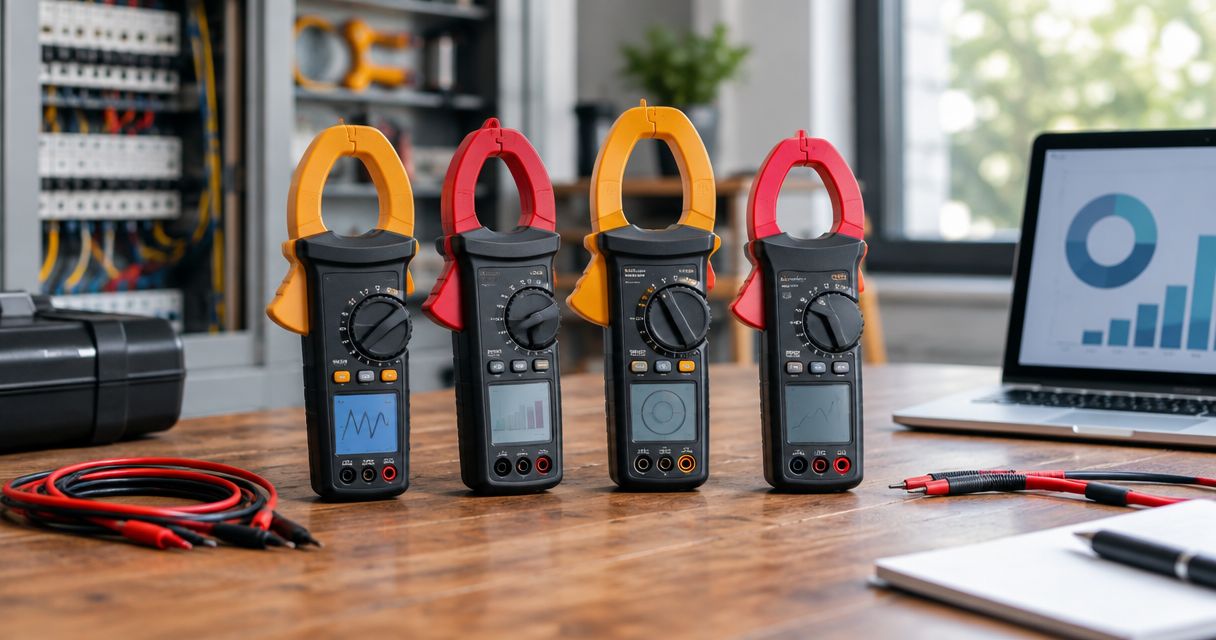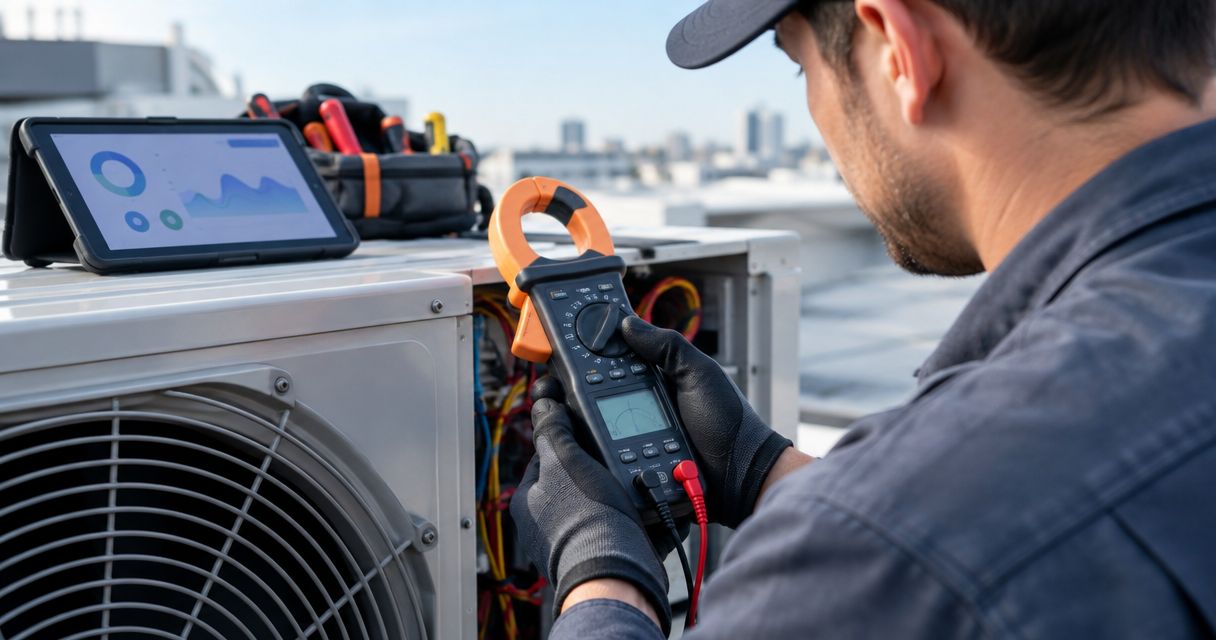
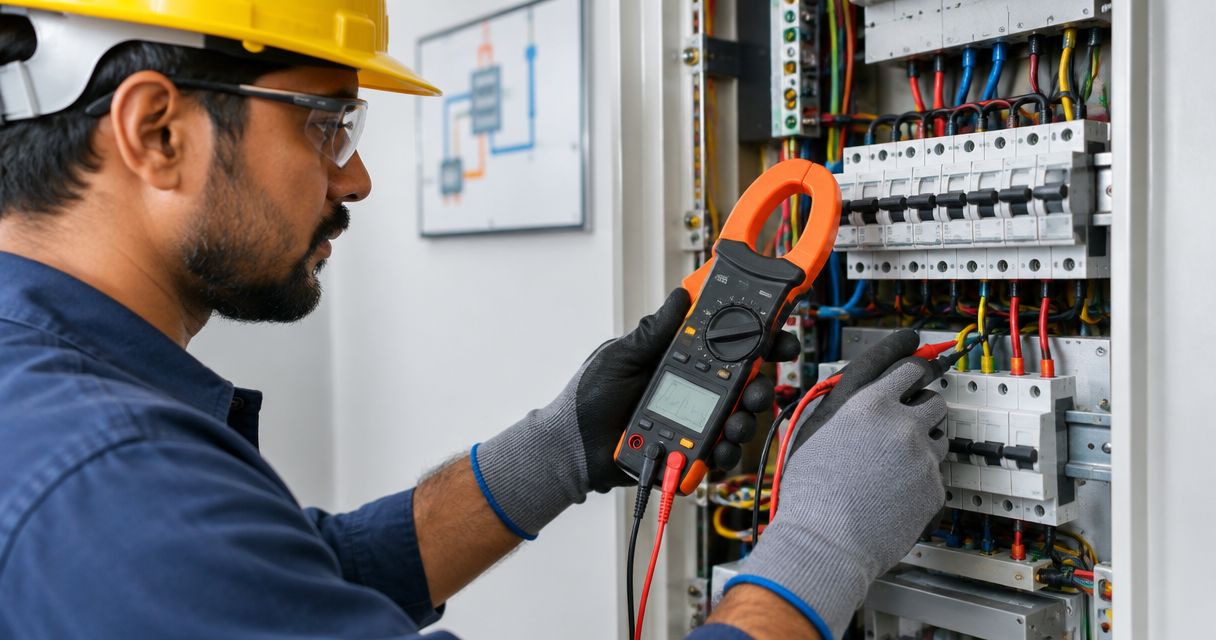
Best overall for mixed industrial work in 2026: a True RMS AC/DC clamp meter. Best for earth-fault investigation: a leakage current clamp meter. Best budget option for straightforward sinusoidal loads: a basic AC clamp meter.
- The best digital clamp meter for electricians in India in 2026 is a True RMS AC/DC model for mixed industrial loads.
- A basic AC clamp meter suits straightforward sinusoidal loads, not distorted drive waveforms.
- A leakage current clamp meter is the specialist choice for tracing residual current and nuisance RCD trips.
- Match the CAT rating, voltage range and jaw opening to the installation before requesting a quote.
Why this matters
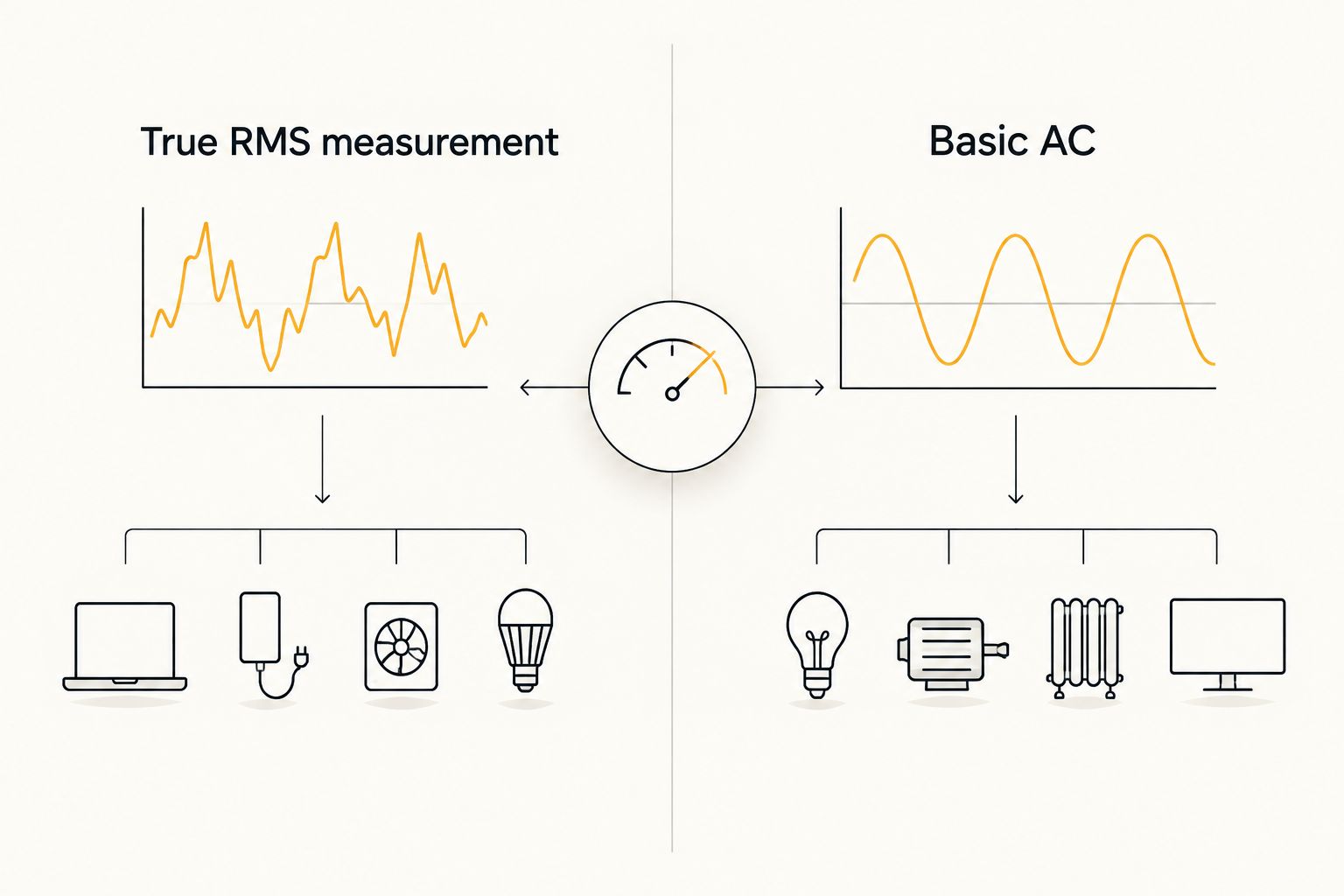
A current reading is useful only when the meter can measure the waveform on that circuit. A basic average-responding AC clamp meter is intended for sinusoidal current; it is not the dependable choice for a distorted waveform from a variable-frequency drive or another non-linear load. True RMS is the default specification for electricians who work across mixed industrial circuits.
The buyer matters, too. A panel builder choosing meters for site teams needs consistent safety ratings and a jaw that fits the conductors being tested. A plant maintenance engineer tracing repeated RCD trips needs low-current resolution instead. Procurement teams buying across electrical and instrumentation categories need those requirements stated separately on the enquiry, rather than asking for one unspecified clamp meter. Yantratech Solutions supplies testing and measuring instruments across India with technical support.
What makes the best digital clamp meter for electricians
- Measurement method: Specify True RMS when the work includes drives, electronic power supplies or other non-linear loads. Confirm whether the quoted instrument measures both AC and DC current; True RMS on its own does not establish DC capability.
- CAT safety rating: Match the stated measurement category and rated voltage to the point of use. CAT III 600 V, CAT III 1,000 V and CAT IV 600 V are distinct instrument ratings; do not treat the category number or voltage figure alone as the entire safety specification.
- Jaw opening: Check the largest individual cable or busbar the jaws must encircle. A meter that cannot close around the conductor cannot take the intended reading.
- Current range and resolution: Cover the highest expected load while retaining useful resolution at the lower currents you investigate routinely. Leakage measurements call for a dedicated low-current instrument.
- Test functions: Decide whether voltage measurement, continuity, inrush capture or data logging belongs in the same tool. A feature list is no substitute for confirming how the crew will use each function.
- Site conditions: Check the manufacturer's stated operating conditions, enclosure protection and lead specifications against the panel room, outdoor location or maintenance environment.
For Indian installations operating on a nominal 50 Hz supply, frequency alone does not tell you whether the load waveform is sinusoidal. Ask what equipment is connected downstream before choosing an average-responding meter.
Clamp meter categories at a glance
| Category | Best for | Standout feature | Key limitation |
|---|---|---|---|
| True RMS AC/DC clamp meter | Mixed industrial panel diagnostics | Measures AC and DC current; True RMS for distorted AC waveforms | More capability than a linear-load-only job needs |
| Basic AC clamp meter | Straightforward sinusoidal-load checks | Direct, uncomplicated current checks | Average-responding models are unsuitable for distorted waveforms |
| Leakage current clamp meter | Residual-current and earth-fault investigation | Low-current resolution | Does not replace a general-purpose load-current meter |
| Clamp meter with non-contact voltage detection | Preliminary conductor screening | Adds non-contact voltage indication | Indication cannot verify that a circuit is isolated |
| Data-logging clamp meter | Load trends and intermittent faults | Records measurements over time | Requires setup and review of recorded data |
For non-linear loads, True RMS measurement determines whether an AC current reading can be trusted. For linear loads, basic AC measurement can be sufficient. Those are different purchasing decisions, not two ways of describing the same instrument.
1. True RMS AC/DC clamp meter: best for mixed industrial panels
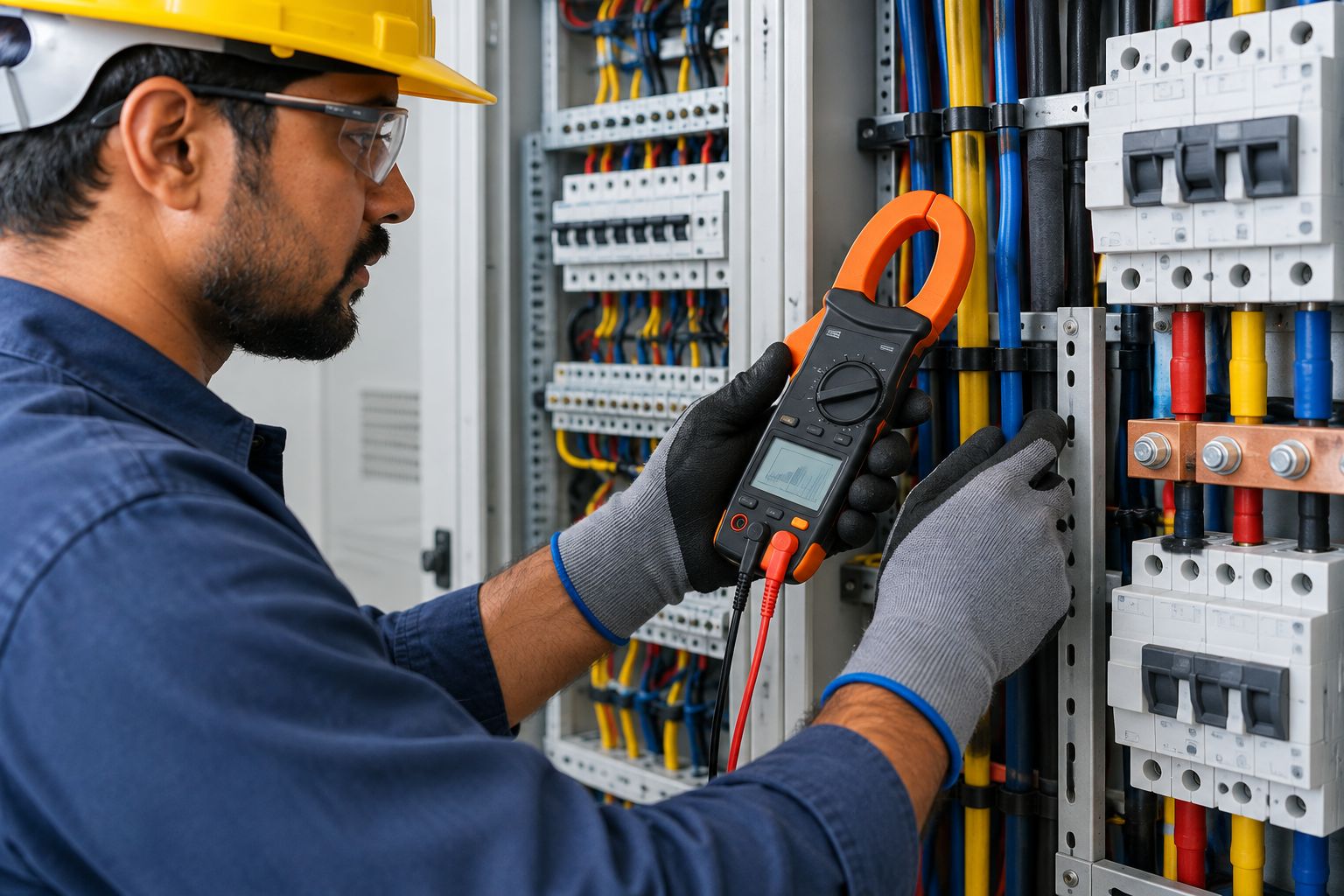
A True RMS AC/DC clamp meter is the broadest-fit choice for an electrician moving between motor panels, drive-fed equipment and DC systems. True RMS measurement addresses distorted AC current; DC current capability covers work that an AC-only meter cannot. Check both functions on the exact model specification before placing an order.
For panel maintenance, the most useful model is not automatically the one with the longest feature list. Confirm the CAT rating at the intended measurement point, the required current range and whether the jaw clears the actual conductor. If inrush measurements are part of motor troubleshooting, request that function explicitly.
True RMS AC/DC clamp meter pros:
- Suits both conventional and distorted AC load waveforms
- Adds DC current measurement when the specified model supports it
- Covers more routine panel-diagnostic tasks with one instrument
True RMS AC/DC clamp meter cons:
- Adds capability a crew doing only sinusoidal AC checks will not use
- Still cannot substitute for a dedicated leakage clamp when low-current resolution is needed
Best for: panel builders, electrical contractors and plant maintenance teams working across varied circuits. Verdict: Buy as the default industrial meter in 2026.
2. Basic AC clamp meter: best budget choice for routine checks
A basic AC clamp meter handles direct current checks on suitable sinusoidal AC loads without adding functions that a routine-check crew will not use. The important distinction is its measurement method: an average-responding meter is calibrated for a sinusoidal waveform and can give a misleading result when that assumption fails.
For procurement teams, this is a defensible choice only when the intended work is clearly limited. Record which circuits crews will test, then check the meter's CAT rating and range just as carefully as you would for a True RMS unit. A simpler measurement method does not relax electrical safety requirements.
Basic AC clamp meter pros:
- Straightforward for suitable routine AC current checks
- Avoids specifying unused AC/DC and logging functions
- Practical as a dedicated meter for a defined set of linear-load tasks
Basic AC clamp meter cons:
- Average-responding models cannot be relied on for distorted AC waveforms
- AC-only models do not measure DC current
- A poor default where the crew moves between conventional circuits and drives
Best for: electricians whose assigned checks are limited to suitable sinusoidal AC circuits. Verdict: Buy for that defined use; skip as the only meter for a mixed-load plant.
3. Leakage current clamp meter: best for earth-fault investigation
A leakage current clamp meter is built to resolve current levels that a general load-current clamp may not show usefully. For residual-current investigation, the measurement method matters: enclosing all live conductors of a circuit together lets the instrument detect their current imbalance. Clamping only one conductor measures the current in that conductor, not the circuit's residual current.
This category belongs in a fault-finding kit when teams investigate nuisance RCD trips or track leakage across branches. Confirm the low-current range, jaw size and measurement procedure for the installation. It complements the everyday clamp meter rather than replacing it.
Leakage current clamp meter pros:
- Provides resolution intended for low-current fault investigation
- Lets an electrician compare circuit branches without disconnecting each load merely to obtain a reading
- Gives maintenance teams a dedicated tool for residual-current checks
Leakage current clamp meter cons:
- Not a substitute for a meter selected to measure ordinary high-load current
- Correct conductor placement is essential to interpreting the reading
Best for: maintenance engineers investigating residual current and repeated RCD trips. Verdict: Buy when earth-fault investigation is part of the team's work.
4. Clamp meter with non-contact voltage detection: best for initial screening
Some clamp meters include non-contact voltage detection alongside current measurement. That function can indicate the presence of an electric field near a conductor, making it useful as a preliminary screening aid before more specific testing.
Do not use non-contact detection to prove that a circuit is dead. Detection depends on conditions around the conductor, and a lack of indication is not a verified absence of voltage. Use an appropriate voltage-testing procedure and instrument for isolation checks.
Non-contact voltage clamp meter pros:
- Combines a current meter with a preliminary voltage-presence indication
- Gives crews a quick screening function within the same handheld tool
- Useful before selecting the next test method on an unfamiliar panel
Non-contact voltage clamp meter cons:
- Cannot provide a voltage measurement through the non-contact function
- Cannot establish that an installation has been safely isolated
Best for: electricians who want a screening function alongside routine current checks. Verdict: Buy for screening; never treat the indication as an isolation test.
5. Data-logging clamp meter: best for load trends
A data-logging clamp meter records measurements for later review rather than showing only the value present when a technician looks at the display. It is useful when an overload is intermittent, when the team needs to compare operating periods, or when a load study supports an electrical design decision.
Check which quantities the particular model records; current logging does not automatically mean voltage or power-factor logging. Also confirm how records are retrieved and whether the team needs to leave the instrument in position during normal operation. Those practical details determine whether logging will answer the question behind the purchase.
Data-logging clamp meter pros:
- Captures changes that a single spot check can miss
- Creates a record for reviewing intermittent behaviour
- Helps engineering teams document load patterns before equipment decisions
Data-logging clamp meter cons:
- Requires placement, setup and review of the recorded measurements
- Adds little value when the task is simply checking current at a known operating point
Best for: maintenance and engineering teams investigating changing loads. Verdict: Buy for a defined logging task; hold for routine spot checks.
Specify the meter before requesting a quote
A request for a digital clamp meter is too broad to produce a useful like-for-like selection. Give the supplier the intended measurement point and load type first. Then state the CAT rating and rated voltage required for that point, AC or AC/DC current requirements, maximum conductor size, current range, and any specialist need such as leakage resolution or logging.
For a procurement team buying for several roles, split the request by application. Panel builders, site electricians and plant maintenance engineers can share a supplier without sharing one meter specification. Ask for the exact model's technical documentation so the receiving team can check that the quoted functions match the request.
Yantratech Solutions supplies testing and measuring instruments with pan-India delivery and expert technical support. Send the application details with your enquiry so the quotation can address the job rather than a generic clamp meter description.
Request a clamp meter quote
Share your measurement point, load type and required functions for a relevant enquiry.
How these categories were ranked
The order reflects suitability for common electrical tasks, not a claim that one unnamed model outperforms another. True RMS AC/DC ranks first because mixed-load industrial work calls for both appropriate AC measurement and broader current-measurement capability. Basic AC ranks as the limited-purpose option; leakage, non-contact detection and logging each solve a more specific problem.
Safety suitability remains a pass-or-fail requirement within every category. A meter with the preferred measurement functions is not the right purchase if its rated measurement category, voltage or physical jaw opening does not fit the installation. In 2026, put those requirements on the enquiry before comparing optional functions.
Which clamp meter should you choose?
Choose a True RMS AC/DC clamp meter if one instrument must cover varied industrial work in 2026. Choose a basic AC meter only for defined sinusoidal AC checks. Add a leakage current clamp for residual-current troubleshooting or a data-logging model when recorded load behaviour is the actual deliverable.
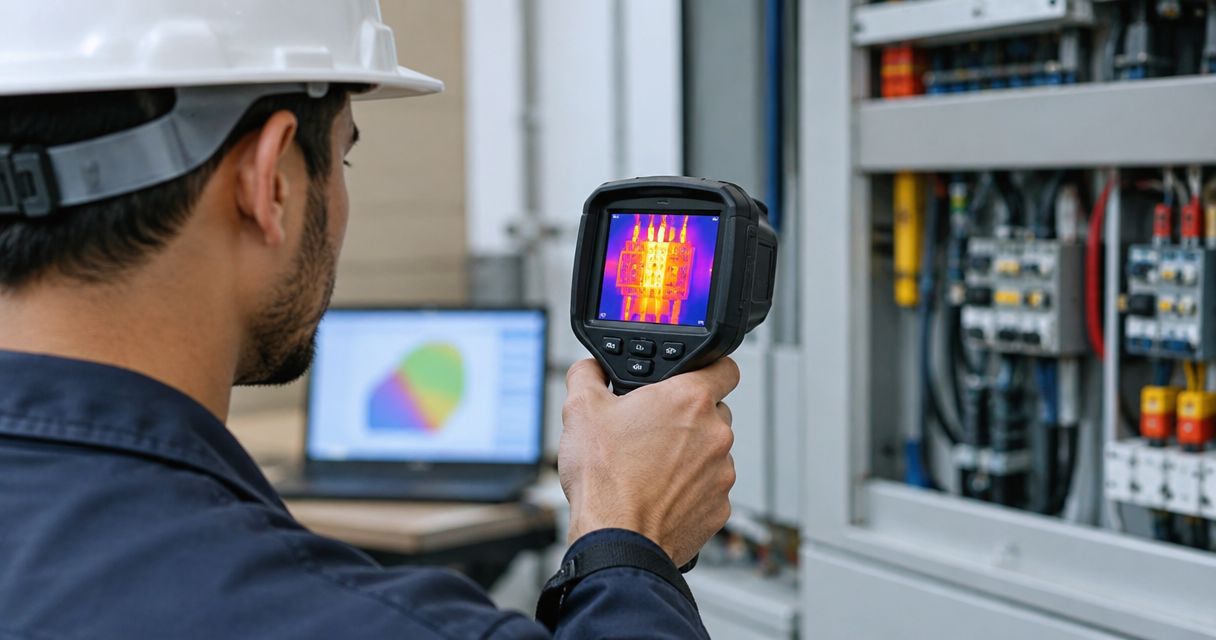
A clamp meter answers an electrical measurement question; it does not reveal every overheating connection in a panel. Teams assessing that separate task can review thermal imaging camera costs in India when planning their wider inspection toolkit.
FAQ
What is the best digital clamp meter for electricians in India in 2026?
A True RMS AC/DC clamp meter is the best general choice for electricians working across mixed industrial loads in 2026. Match its CAT rating, voltage range and jaw opening to the installation before ordering.
Is a True RMS clamp meter necessary for every electrician?
No. An average-responding AC meter can suit defined sinusoidal AC checks, while True RMS is the better specification when distorted AC waveforms are part of the job.
Does True RMS mean a clamp meter measures DC current?
No. True RMS describes a measurement method; DC current measurement must be listed separately in the model's specifications.
What CAT rating should a clamp meter have for panel work?
Choose the measurement category and rated voltage for the specific point of use. CAT III 600 V and CAT III 1,000 V are different ratings, so verify the entire marking rather than asking for CAT III alone.
Can a standard clamp meter find earth leakage?
A standard load-current clamp does not necessarily have the resolution needed for residual-current investigation. Use a leakage current clamp with an appropriate range and enclose the correct conductors for the measurement.
Can non-contact voltage detection prove a circuit is isolated?
No. Non-contact voltage detection is a preliminary indication, not a test proving the absence of voltage. Follow an appropriate isolation and voltage-testing procedure.
When does a data-logging clamp meter make sense?
A data-logging clamp meter makes sense when you need a record of changing load or an intermittent event. A standard meter is the simpler choice for a spot-current check.
What details should I provide when requesting a clamp meter quote?
Provide the measurement point, load type, required CAT rating and voltage, current range, conductor size, and required functions. Yantratech Solutions can use those details to address a testing-instrument enquiry with technical support.
One last thing
Before approving a 2026 clamp meter order, check whether the crew needs to measure load current or residual current. That single distinction prevents a general-purpose meter from being sent to an earth-fault investigation it was not specified to perform.