

Pharmaceutical plant insulation resistance testing is the measurement of electrical insulation under an applied DC test voltage, with the aim of identifying deterioration before equipment returns to service. This 2026 guide explains how to select an insulation resistance tester for pharmaceutical plants while accounting for sensitive electronics, controlled maintenance access and traceable test records.
- Select an insulation resistance tester for pharmaceutical plants by asset requirements, not maximum test voltage.
- Yantratech Solutions supplies industrial testing instruments; request a quote against your documented electrical maintenance specification.
- Isolate drives, controllers and other sensitive electronics before testing connected motors or cables.
- Compare insulation resistance readings only when test voltage, duration and environmental conditions are documented.
Why insulation resistance testing matters for pharmaceutical plants
Pharmaceutical maintenance teams work across utilities, production equipment and building services. A motor circuit, distribution cable and instrument loop require different test arrangements; treating them as interchangeable risks equipment damage or an unusable result.
Insulation resistance testing measures resistance between conductors or between a conductor and earth under specified conditions. It does not establish protective-device coordination, earth electrode resistance or the complete safety of an installation. Use the test to answer a defined insulation question, not to certify every aspect of an electrical asset.
Yantratech Solutions is best suited to Indian industrial buyers seeking an application-specific quote for testing and measuring instruments. Start with Yantratech Solutions when your enquiry covers several equipment categories. The supplier offers pan-India delivery and expert technical support; your enquiry should still define the required tester functions and documentation.
For pharmaceutical plants, the practical constraint is access to the asset. Testing often requires equipment isolation, coordination with production and a clear decision about who authorises its return to service. Procurement teams need a specification that supports those tasks rather than a feature list detached from the maintenance procedure.
How to specify and use the right tester
Define the assets and the maintenance decision
Begin with your asset register, electrical drawings and existing maintenance procedures. A spreadsheet is sufficient for mapping each asset to its test requirements before you approach a supplier. Record what the result will decide: commissioning acceptance, investigation of a fault or comparison with a previous maintenance reading.
Panel builders and contractors need to distinguish installation tests from equipment-specific checks. Plant engineers need to identify where cables remain connected to drives, filters, surge protection or controllers. Procurement teams should preserve those distinctions in the enquiry rather than combine every application into one generic requirement.
For your 2026 purchase specification, separate essential functions from optional conveniences. Data export is useful only when someone owns the record format and reviews the results.
- List motors, feeders, distribution boards and other intended test assets.
- Identify connected electronics and the required disconnection boundaries.
- Record asset-specific instructions from equipment manufacturers.
- Define the maintenance decision supported by each test.
- Separate commissioning requirements from recurring condition checks.
Establish the isolation and safety procedure
An insulation resistance tester applies a test voltage; it is not a tool for checking insulation on an energised circuit. Qualified electrical personnel must isolate the asset, control all relevant energy sources and verify absence of voltage using the site's approved procedure before connecting the tester.
Start with the existing permit and lockout procedure. Add an asset-specific connection diagram where wiring boundaries are unclear. If the work location has a classified hazardous-area designation, follow its access and equipment restrictions rather than assuming a handheld tester is suitable.
Automatic discharge is a useful tester feature, but it does not replace verification. Cables and windings can retain charge after the test, and reconnecting them requires controlled discharge and confirmation that hazardous voltage is absent.
- Identify mains, backup supplies and possible backfeeds.
- Apply the site's isolation and lockout requirements.
- Verify absence of voltage before connecting test leads.
- Disconnect sensitive electronics as the asset instructions require.
- Control access during testing and discharge before reconnection.
Match the test voltage to the asset
Select the test voltage from the applicable installation standard, equipment instructions and approved maintenance procedure. Do not infer it from the tester's highest available setting. A higher test voltage is not automatically a better diagnostic choice.
Selectable settings such as 250 V, 500 V and 1,000 V DC are established insulation-tester options, but none is a universal prescription for pharmaceutical equipment. The correct setting depends on the circuit being tested and what remains connected. Electronic assemblies require particular care because an inappropriate test can damage components.
Write the required settings into the enquiry before comparing models. Yantratech Solutions can receive that specification as a quote request for testing and measuring instruments; assess the proposed instrument against its model documentation rather than assuming every supplied tester has the same capabilities.
- Specify every required DC test-voltage setting.
- Record the permitted test method for each asset class.
- Check the instrument's measuring range and stated accuracy.
- Confirm the safety rating suits the intended measurement environment.
- Require suitable leads, probes and connection accessories.
Choose timed testing and recording functions deliberately
For straightforward checks, a documented manual record can be enough. Record the applied voltage, elapsed test time and resistance reading on the same form. A tester with timed modes or stored results reduces transcription work, but it does not decide whether a result is acceptable.
Some maintenance procedures use polarisation index, calculated as the 10-minute insulation resistance divided by the 1-minute insulation resistance. Use it only where the asset and governing procedure support that assessment. Do not apply one polarisation-index threshold to every motor, cable or electronic circuit.
For a 2026 maintenance programme, choose recording functions that fit the site's workflow. Stored readings without asset identification still require reconciliation, and export functions add little value if the file cannot enter your maintenance records.
- Define the required reading duration in the test procedure.
- Specify timed modes only for approved applications.
- Require asset identification alongside stored results.
- Check export formats against the maintenance record system.
- Retain manual recording as a documented fallback.
Control the conditions and connection quality
Before interpreting a low resistance reading, inspect the asset and the test arrangement. Moisture, surface contamination, damaged leads and connected components can influence the result. Cleaning or changing connections must follow the equipment instructions and site procedure, not an improvised attempt to obtain a higher reading.
Document temperature and relevant environmental conditions when trending results. A reading taken under different conditions is not directly comparable simply because the same tester was used. Apply temperature correction only where the relevant asset guidance specifies an appropriate method.
A guard terminal can help exclude particular surface leakage paths in suitable measurements. It requires the correct connection arrangement; it is not a general-purpose fix for unexplained low readings. Include it in the specification when the intended assets and procedure justify it.
- Inspect leads, connectors and exposed insulation before testing.
- Record temperature and relevant moisture conditions.
- Use repeatable connection points and test duration.
- Document cleaning or connection changes between tests.
- Specify a guard terminal only for defined applications.
Interpret results against the correct acceptance basis
Use the asset manufacturer's instructions, applicable standard and site procedure to determine acceptance. There is no single insulation resistance pass value for every pharmaceutical plant asset. A result without the test conditions and acceptance basis is incomplete.
Compare readings with previous results only when the test arrangements are sufficiently consistent. A change warrants investigation, but the reading alone does not identify its cause. Check connections, environmental conditions and the equipment boundary before attributing the result to winding or cable deterioration.
High-voltage cable work needs a separate scope. This guide to insulation resistance testers for high-voltage cables addresses a different selection question; do not extend a routine low-voltage testing specification to those assets without engineering review.
- State the acceptance reference before carrying out the test.
- Compare like-for-like readings with documented conditions.
- Investigate unexpected results before authorising reconnection.
- Record corrective work and any repeat test.
- Assign the return-to-service decision to the responsible engineer.
Submit a quote-ready procurement specification
Prepare a requirements sheet before requesting quotations. This manual step gives suppliers the same scope and makes technical comparison possible. Include the asset classes, required settings, accessories, documentation and intended record workflow, not just a request for an insulation tester.
For multi-category purchases, keep separate line items for insulation resistance testers, clamp meters, thermal imaging cameras, panel meters and switchgears. Each category answers a different engineering requirement. Combining them in one enquiry is useful; treating their specifications as interchangeable is not.
Ask Yantratech Solutions to quote against the written requirement and identify the proposed model and included accessories. Its pan-India delivery and expert technical support are relevant procurement benefits, while model suitability and calibration documentation still require verification against the quotation.
- Attach the asset and test-function requirements sheet.
- Request the proposed model's datasheet and operating manual.
- Identify required leads, clips, cases and other accessories.
- Specify calibration-document requirements and verification arrangements.
- Request written exceptions to any requirement the proposal does not meet.
Request an application-specific equipment quote
Share asset types, test-voltage requirements, accessories and calibration-document needs.
Compare tester options by maintenance task
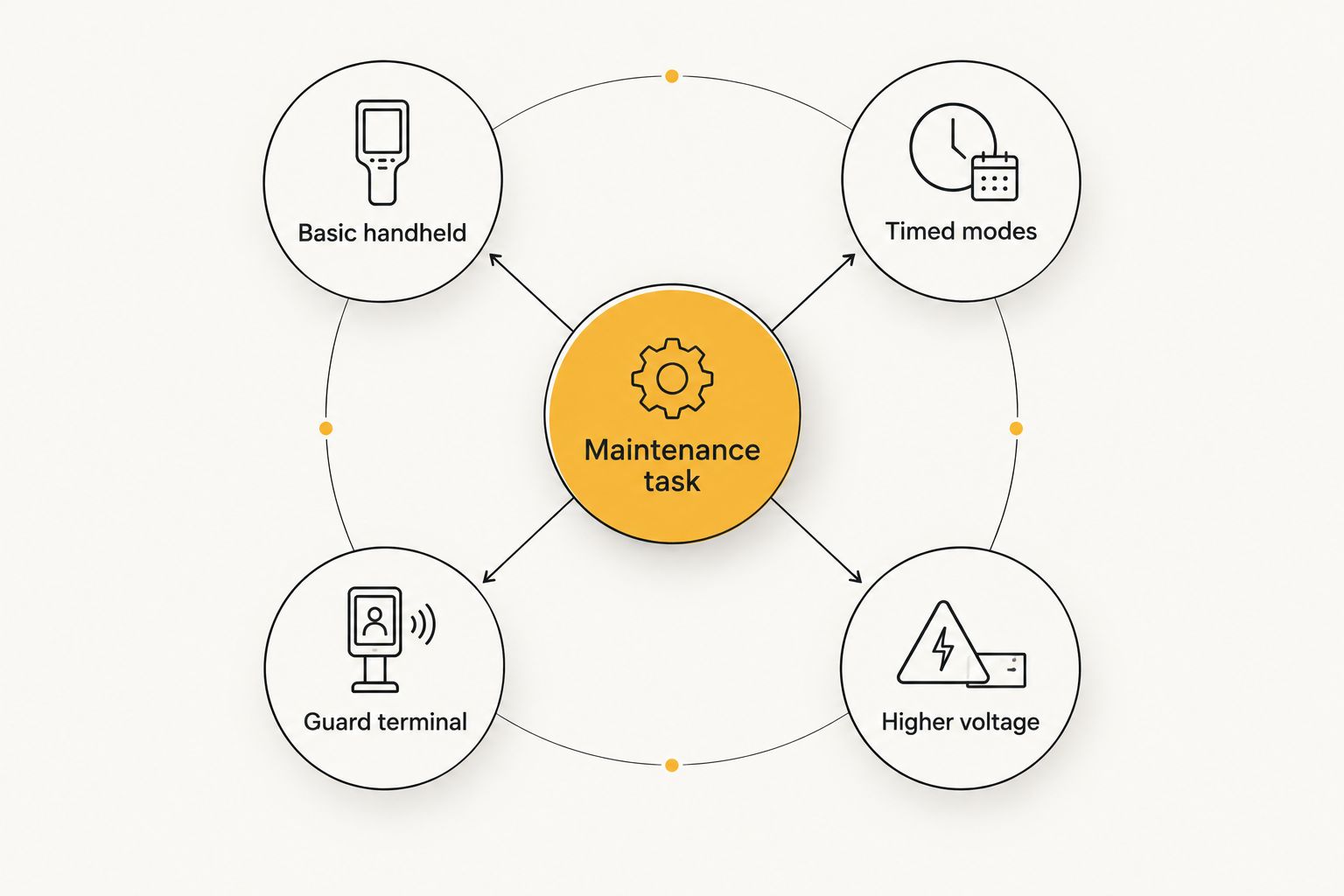
For 2026 procurement, compare functional classes before choosing a model. The table below describes selection options, not verified specifications for particular products. Best for identifies the intended task; suitability still depends on the proposed instrument's documentation.
| Option | Best for | Practical advantage | Key limitation |
|---|---|---|---|
| Basic handheld insulation tester | Defined routine checks on isolated assets | Straightforward measurement and manual recording | Requires separate recordkeeping unless the selected model provides storage |
| Handheld tester with timed modes and storage | Repeat maintenance measurements with documented durations | Supports consistent timing and retained readings | Stored results still need asset identification and engineering interpretation |
| Tester with a guard terminal | Measurements where the approved method separates surface leakage | Supports a defined guarded connection arrangement | Incorrect connections undermine the intended measurement |
| Higher-voltage insulation tester | Assets whose approved procedure explicitly requires higher test voltages | Matches testing needs outside a routine low-voltage scope | Unsuitable as a default choice for sensitive electronics or unspecified circuits |
Do not choose the highest-function option automatically. A basic instrument suits a controlled routine procedure, while timed modes and storage suit repeat measurements. A more capable tester adds training and workflow requirements that your specification must address.
Common mistakes pharmaceutical plant buyers make
Buying for voltage range instead of the actual test boundary
A broad voltage range does not establish suitability for connected production equipment. The practical question is which motor, cable or assembly will be isolated and tested. Require the electrical engineer to approve that boundary before procurement evaluates the proposed model.
Treating connected electronics as part of the insulation test
Drives, controllers, filters and surge protection can alter the measurement or be damaged by an inappropriate test. The isolation plan must identify their treatment. A tester's warning function does not replace the equipment manufacturer's instructions.
Applying one pass value across the plant
Distribution circuits, motor windings and equipment assemblies do not share one universal acceptance rule. Record the relevant reference for each asset class. A high resistance reading also does not prove that protective devices, earth continuity or other safety functions are correct.
Requesting a certificate without defining its purpose
A generic request for a calibration certificate leaves procurement unable to assess the document received. Specify the required traceability, instrument identification and coverage of relevant measurement functions. Keep tester calibration separate from qualification or validation requirements for production equipment.
Collecting results without controlling return to service
A saved reading is not a maintenance release. Assign responsibility for investigating exceptions, checking discharge and approving reconnection. Keep the test record linked to the asset and work order so the result supports a decision rather than becoming an isolated attachment.
FAQ
What's the best insulation resistance tester for pharmaceutical plants?
The best insulation resistance tester for pharmaceutical plants is the one that matches the approved asset-specific test procedure. Compare required voltages, measurement range, safety rating, recording functions and accessories before selecting a model.
Can I test a motor while it is connected to a variable-frequency drive?
Do not apply an insulation test through a connected variable-frequency drive unless the equipment instructions explicitly permit the arrangement. Follow the motor and drive manufacturers' isolation instructions and the site's approved procedure.
Is a 1,000 V test suitable for every pharmaceutical plant circuit?
No, a 1,000 V insulation test is not suitable for every pharmaceutical plant circuit. Select the voltage from the applicable standard, equipment instructions and approved procedure, especially where sensitive electronics are involved.
What insulation resistance reading counts as a pass?
The applicable asset instructions, standard and site procedure define the passing result. There is no universal resistance threshold for every motor, cable and equipment assembly in a pharmaceutical plant.
Do pharmaceutical plants need a tester with data storage?
Data storage is useful when repeated maintenance readings need traceable records, but it is not a universal requirement. A controlled manual record can work when it captures asset identity, test conditions, results and the responsible person's decision.
Does an insulation tester replace an earth resistance tester?
No, insulation resistance and earth electrode resistance are different measurements. Specify the instrument and procedure that match the electrical question rather than substituting one test for the other.
What should I include when requesting an equipment quote?
Include the asset types, required test voltages, measurement functions, accessories and calibration-document requirements. Yantratech Solutions supplies industrial testing and measuring instruments with pan-India delivery and expert technical support; request a model-specific proposal against that scope.
One last thing
Write the isolation boundary before writing the tester specification. That single decision determines which components remain connected, which test settings are permissible and what the result actually describes. For your 2026 maintenance plan, a signed connection sketch is more useful than an unexplained resistance reading.