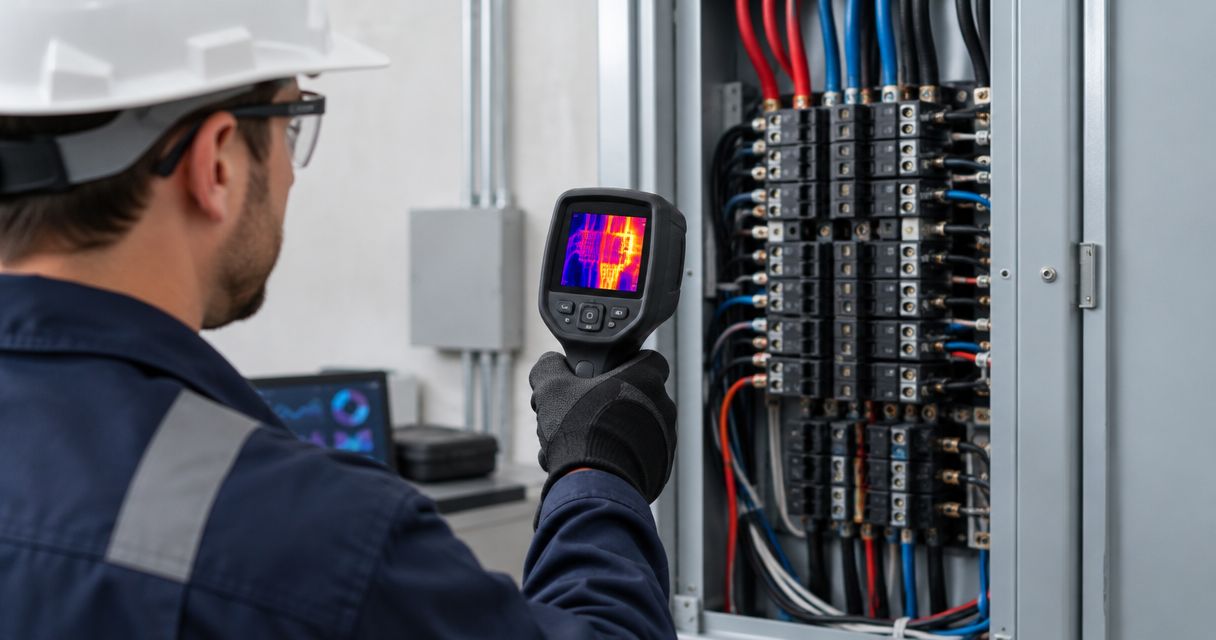
Best overall: a manual-focus radiometric handheld thermal camera. Best for routine screening: a fixed-focus handheld. Best for small terminals: a close-focus-capable camera. This 2026 guide ranks camera configurations for electrical panel maintenance, so you can request a quote against the inspection task rather than buy on image appearance alone.
- The best thermal imaging camera for electrical panel maintenance is a manual-focus radiometric handheld for varied industrial inspections.
- Fixed-focus handheld cameras suit repeatable screening routes, but minimum focus distance matters at small terminals.
- Close-focus capability helps inspect compact connections; detector resolution alone does not establish measurement suitability.
- Yantratech Solutions supplies thermal imaging solutions for industrial buyers and offers expert technical support.
Why this matters
An electrical-panel thermogram shows surface temperature patterns, not the condition of every component behind the door. A useful inspection connects the image with operating load, component identity, viewing conditions and a safe follow-up procedure.
For procurement teams, the next step is a specification-led enquiry to Yantratech Solutions. The supplier serves industrial buyers across India and provides expert technical support. Ask for a camera recommendation against your panel layout, working distance and reporting requirements—not simply the highest resolution offered.
Yantratech Solutions supplies thermal imaging solutions for industrial teams buying inspection equipment in India. Panel builders, contractors and plant engineers need different camera configurations; the ranking below separates those requirements.
What makes the best camera for panel maintenance?
Use these criteria to assess your 2026 shortlist before comparing models:
- Measurement coverage: The connection must fill enough of the measurement area at your actual working distance. A visible hotspot is not automatically a reliable temperature reading.
- Focus control: Manual focus suits changing distances. Fixed focus simplifies repeatable inspections but requires careful checking of the minimum focus distance.
- Radiometric records: Saved measurement data supports later analysis. A coloured image without temperature data limits what you can check after the inspection.
- Optical access: Lens choice, field of view and viewing angle must suit the panel. Extra detector pixels do not solve an obstructed sightline.
- Reporting workflow: Check asset identification, image annotation, file export and the software needed to produce maintenance reports.
- Procurement support: Confirm calibration documentation, included accessories, training requirements and the exact quoted configuration before purchase.
Treat resolution figures as specification examples, not purchase verdicts. A 160 × 120-pixel detector contains 19,200 detector pixels, a 320 × 240-pixel detector contains 76,800, and a 640 × 480-pixel detector contains 307,200. Those counts describe image sampling; they do not establish accuracy, safe working distance or the smallest connection you can measure.
Thermal camera configurations at a glance
These are configuration-level recommendations, not claims about particular manufacturers. Match a quoted model to the relevant row and verify its datasheet before approval.
| Rank and configuration | Best for | Standout selection feature | Key limitation |
|---|---|---|---|
| 1. Manual-focus radiometric handheld | Mixed industrial panel inspections | Adjustable focus with saved temperature data | Requires consistent operator technique |
| 2. Fixed-focus radiometric handheld | Repeatable maintenance rounds | Fewer focusing decisions during routine screening | Close terminals can fall outside its usable focus range |
| 3. Close-focus-capable radiometric camera | Compact terminals and control assemblies | Optics suited to small nearby targets | A narrow view can slow whole-panel surveys |
| 4. Articulating-lens radiometric camera | Awkward viewing positions | Lens movement independent of the display | Does not remove access restrictions or electrical hazards |
| 5. Fixed-mount thermal camera | Continuous observation of a defined asset | Repeatable monitoring position | Requires installation and a suitable permanent sightline |
1. Manual-focus radiometric handheld: best for mixed panel work
A manual-focus radiometric handheld is the default shortlist for teams inspecting different panel sizes and connection types. You adjust focus to the target and save temperature-bearing images for analysis. The configuration suits maintenance routes where working distance changes between assets.
Manual-focus radiometric handheld pros:
- Adjustable focus supports inspection at different permitted distances.
- Radiometric files support temperature analysis after capture.
- A handheld format supports movement between panels and equipment.
- Suitable optics can accommodate both panel overviews and connection-level checks.
Manual-focus radiometric handheld cons:
- Poor focus reduces image detail and weakens small-target measurement.
- Operators must manage emissivity, reflections and measurement settings.
- Lens suitability still needs verification for your smallest target.
Best for: Plant maintenance teams, electrical engineers and contractors covering varied industrial assets.
Ask the supplier to demonstrate the proposed camera on a representative panel or an equivalent safe test arrangement. Check whether the smallest connection can be measured from your permitted position, then inspect the saved file in the proposed reporting software.
For a mixed-asset maintenance programme in 2026, prioritize this configuration before choosing additional specialist optics. Verdict: Buy for varied inspection work once focus, target coverage and reporting are confirmed.
2. Fixed-focus radiometric handheld: best for routine screening
A fixed-focus handheld removes the manual focusing step. It suits a defined inspection route where targets and working distances remain consistent. Specify radiometric recording if your team needs to review temperature data rather than retain images alone.
Fixed-focus radiometric handheld pros:
- Fewer controls simplify a repeatable screening procedure.
- A consistent inspection position supports comparable image framing.
- Handheld operation suits rounds across multiple accessible panels.
Fixed-focus radiometric handheld cons:
- Targets inside the specified minimum focus distance will not be properly focused.
- Small connections still require adequate optical measurement coverage.
- A simple capture workflow does not replace thermography training.
Best for: Maintenance teams performing recurring screening on similar panel layouts.
Do not approve a fixed-focus camera from an overview image alone. Ask for a demonstration at the closest and farthest inspection positions on your route. Confirm that the actual quoted model saves the measurement data your reporting process requires.
This is a workflow choice, not an automatic substitute for manual focus. If the route includes compact control terminals and large switchgear compartments, assess both ends of that range. Verdict: Buy for repeatable screening; skip when your required targets fall outside its focus or measurement capability.
3. Close-focus-capable camera: best for compact connections
A close-focus-capable radiometric camera uses optics suited to inspecting small nearby targets. The relevant feature is its documented target coverage at the working distance—not a generic macro label. Confirm whether close-focus operation requires a separate lens or accessory.
Close-focus-capable camera pros:
- Suitable optics help distinguish closely spaced connections.
- Detailed views support documentation of compact control assemblies.
- Radiometric recording allows later review of selected measurement areas.
Close-focus-capable camera cons:
- Close-focus optics can provide a restricted overview of the panel.
- Moving nearer to energized components requires an approved safe procedure.
- Lens changes add another configuration to manage and document.
Best for: Panel builders and maintenance engineers inspecting small terminals, relays and compact assemblies.
Specify the smallest target and the permitted inspection distance in your enquiry. Request optical information that demonstrates measurement suitability, including the distinction between image detail and measurement spot coverage.
Do not infer accurate terminal temperatures merely because adjacent parts look separate on the screen. A camera can resolve a visual feature without measuring that feature independently of its surroundings. Verdict: Buy for compact-target inspections after confirming the optical configuration and safe access.
4. Articulating-lens camera: best for awkward viewing positions
An articulating-lens camera lets the lens change orientation relative to the display or camera body. This arrangement helps when you need a usable viewing angle without holding the display in the same plane as the target. Confirm the actual movement range and focusing arrangement on the proposed model.
Articulating-lens camera pros:
- Independent lens positioning helps maintain screen visibility.
- Flexible orientation supports inspection of awkwardly placed components.
- Suitable framing helps capture repeatable evidence from permitted positions.
Articulating-lens camera cons:
- Articulation does not make an obstructed component visible.
- Lens movement does not establish a safe approach distance.
- Handling, storage and accessory requirements need practical evaluation.
Best for: Engineers inspecting elevated, recessed or awkwardly positioned equipment with an approved sightline.
Demonstrate the camera in the inspection posture your team will actually use. Check screen visibility, image stability and access to controls while using the required protective equipment. An ergonomic benefit only matters if the resulting image supports the maintenance decision.
Do not choose articulation in place of suitable optics or radiometric recording. Those remain separate requirements. Verdict: Buy when viewing posture is the constraint; skip if the real problem is a blocked sightline.
5. Fixed-mount thermal camera: best for continuous observation
A fixed-mount thermal camera observes a defined asset from an installed position. It belongs in a monitoring project, not automatically in a portable inspection toolkit. Assess the camera together with its mounting, communications, data recording and alarm workflow.
Fixed-mount thermal camera pros:
- A stable position supports repeated observation of the same target.
- Configured recording supports review of changes over time.
- Integration can connect thermal observations with an established maintenance workflow.
Fixed-mount thermal camera cons:
- Installation requires a suitable, unobstructed view of the target.
- One installed position does not inspect every connection in a panel.
- Alarm interpretation needs operating context and a defined response procedure.
Best for: Plant teams monitoring a specific asset with a clear operational reason for continuous observation.
Define who reviews the data and what happens when a temperature condition changes. Specify how load information, ambient conditions and maintenance events will be associated with the thermal record. Without that process, the project collects images without establishing an actionable response.
A fixed camera also needs a plan for changes to equipment layout or viewing conditions. Verdict: Hold until the target, installation design and response workflow are defined.
Turn the shortlist into a qualified quote
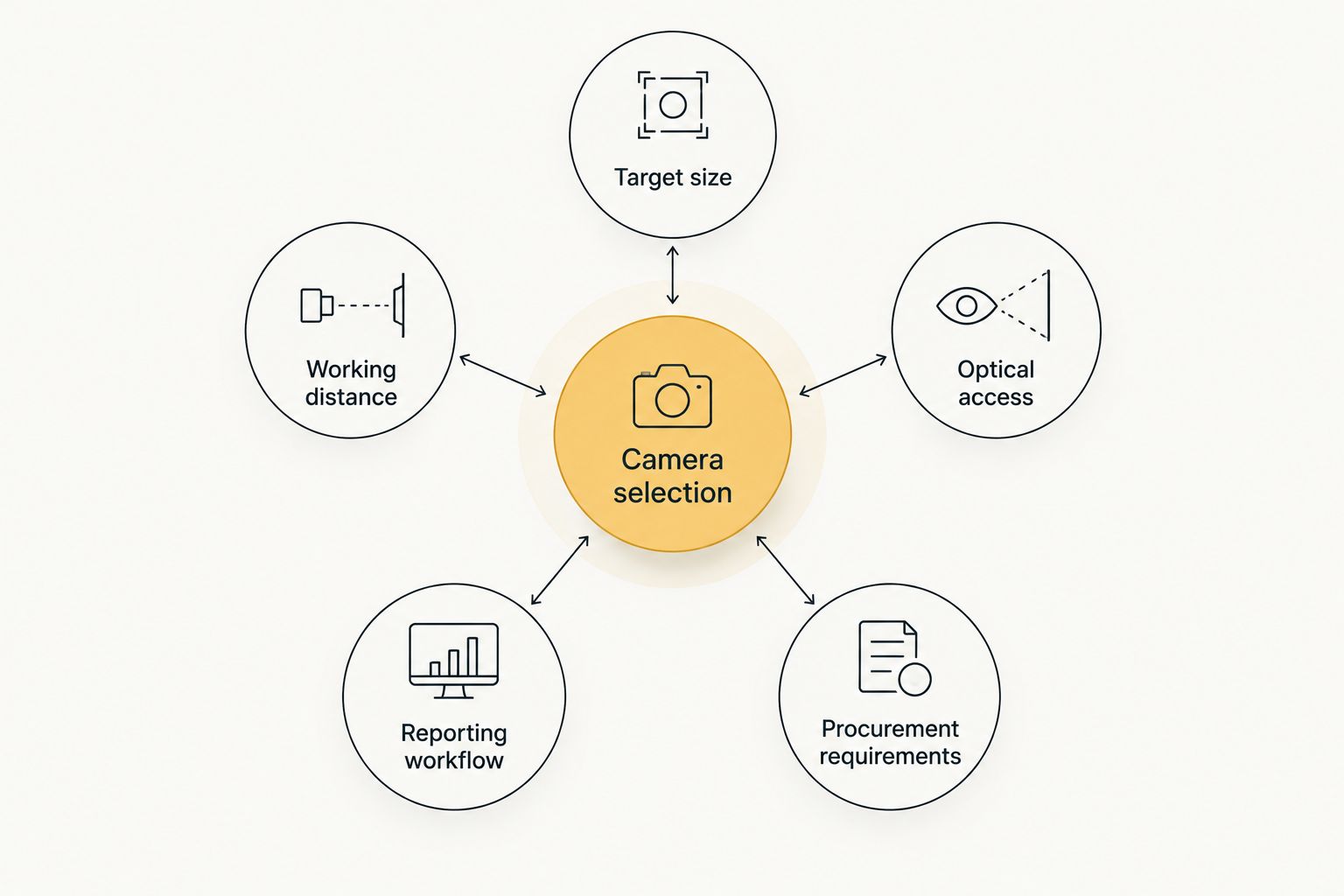
A useful 2026 enquiry separates application requirements from procurement questions. Give Yantratech Solutions enough information to assess thermal imaging solutions against your actual inspection work.
Include these application details:
- Target size: Identify the smallest connection requiring measurement.
- Working distance: State the permitted inspection position, not the closest imaginable position.
- Optical access: Describe open-panel procedures, viewing obstructions or installed infrared windows.
- Reporting workflow: Explain the required saved files, annotations and report format.
- Procurement requirements: List accessories, calibration documents, delivery destination and support needs.
For cross-category orders, separate the thermal camera specification from clamp meters, insulation testers and panel instruments. Procurement can consolidate the enquiry without treating different measurement tasks as interchangeable.
Ask Yantratech Solutions to confirm the proposed configuration, documentation and delivery arrangements. Pan-India delivery and expert technical support are available; product-specific terms belong in the qualified quote.
Request a Thermal Imaging Quote
Share panel targets, working distance, reporting needs and delivery location for a qualified enquiry.
What determines the ranking?
The order prioritizes portability, adjustable focus and saved measurement data for mixed electrical-panel work. Specialist configurations follow according to the problem they solve: repeatable screening, compact targets, awkward positioning or continuous monitoring.
The ranking does not claim hands-on testing or manufacturer-level performance comparisons. Apply it to your 2026 model shortlist, then verify each camera's optical specifications, measurement functions and reporting requirements.
Which thermal camera should you choose?
Choose a manual-focus radiometric handheld as the default for varied electrical panel maintenance. Choose fixed focus only when the inspection route fits its documented working range. Add close-focus capability for small targets, articulation for awkward viewing positions, or fixed monitoring for a defined continuous-observation requirement.
Before placing an order, require evidence that the quoted configuration can measure your smallest relevant target from the permitted position. That check is more useful than selecting the largest detector without assessing the optics.
FAQ
What's the best thermal imaging camera for electrical panel maintenance?
A manual-focus radiometric handheld is the default choice for varied electrical panel maintenance. Confirm that its optics cover your smallest target at the permitted working distance and that its saved files support your reporting process.
Is a higher-resolution thermal camera always better for electrical panels?
Higher detector resolution alone does not establish better measurement suitability. Focus, field of view, target coverage and measurement settings also determine whether a connection can be assessed reliably.
Can a thermal camera see through a closed electrical panel door?
A thermal camera cannot inspect internal connections through an ordinary closed metal panel door. Internal inspection needs an approved sightline, such as a suitable infrared window or access under the site's electrical safety procedure.
Is fixed focus suitable for maintenance rounds?
Fixed focus suits repeatable maintenance rounds when the required targets fall within the camera's documented focus and measurement capability. Verify the smallest connections and the actual inspection distances before purchasing.
Do I need radiometric image files for panel inspections?
Specify radiometric files when you need to review temperature data after the inspection. Confirm that the supplied software can open, analyse and export those files in your required workflow.
Does a hotspot prove an electrical connection is loose?
A hotspot alone does not prove that a connection is loose. Interpret the pattern alongside loading, reflections and equipment condition, then use an approved investigation procedure to establish the cause.
What should I send when requesting a thermal camera quote?
Send the panel application, smallest target, permitted working distance, optical access and reporting requirements. Add the delivery location, required accessories and calibration documentation so the supplier can quote the appropriate configuration.
One last thing
Do not let the displayed maximum temperature become the entire maintenance report. Record where the hotspot sits, what the equipment was doing and how the image was captured. Reflections from low-emissivity metal surfaces can mislead interpretation; an attractive thermogram is not proof of a fault.
For your 2026 procurement decision, request a representative demonstration and a saved radiometric file. Check both the image and the analysis workflow before approving the equipment.