

Best overall: a high-current, four-wire DC micro-ohmmeter matched to the switchgear manufacturer's test procedure. Best for remote maintenance: a battery-powered high-current unit; best for repeated workshop testing: a continuous-duty configuration; best budget-focused choice for panel joints: a lower-current Kelvin instrument, only where the approved procedure permits it.
- The best low resistance ohmmeter for switchgear testing uses four-wire measurement and the test current required by the equipment manufacturer.
- Choose battery operation for remote switchgear maintenance and verified continuous-duty capability for repeated workshop tests.
- Lower-current Kelvin instruments suit approved joint measurements, not automatic substitution for high-current breaker testing.
- Yantratechsolutions supports Indian industrial procurement with pan-India delivery and expert technical support; request an application-specific equipment quote.
Why this matters
A resistance reading is useful only when the test method matches the component. Breaker contacts, busbar joints and cable terminations need defined measurement points, suitable current and repeatable connections—not just a meter that displays micro-ohms.
For your 2026 procurement shortlist, separate electrical suitability from purchasing convenience. A portable instrument can be easy to carry yet unsuitable for the required current or test duration. A workshop instrument can meet the electrical requirement but complicate site work.
Yantratechsolutions supplies industrial testing and measuring instruments alongside switchgears and panel meters. Indian procurement teams can request a quote with pan-India delivery and expert technical support, specifying the required test configuration rather than asking for a generic resistance meter.
What makes the best switchgear low-resistance ohmmeter?
Use these criteria before comparing equipment configurations:
- Required test current: Follow the switchgear manufacturer's procedure. A 100 A DC instrument is a relevant high-current procurement class, not a universal requirement for every joint or breaker.
- Four-wire measurement: Specify 4-terminal Kelvin connections, with separate current and voltage-sensing paths. This arrangement reduces the contribution of lead resistance to the measured result.
- Measurement quality: Compare accuracy, uncertainty, measuring range and thermal-offset handling. A display resolution of 1 µΩ does not establish measurement accuracy of 1 µΩ.
- Duty cycle: Confirm how long the instrument delivers the required current and what recovery period applies between tests. Maximum current alone does not describe sustained operation.
- Lead suitability: Check lead length, conductor size, clamp geometry and access to the actual measurement points. Supplied accessories must suit the switchgear layout.
- Procurement evidence: Request the relevant datasheet, calibration documentation, accessory list and support scope. Keep each requirement in the purchase specification.
Choose the test method first, then the instrument. That sequence prevents procurement from selecting equipment around an attractive current rating while overlooking the connection arrangement or duty cycle.
Low-resistance ohmmeters at a glance
This 2026 shortlist ranks equipment configurations by application. The configurations can overlap: a battery-powered instrument can also have high-current capability. The deciding factor is which requirement governs your purchase.
| Rank and configuration | Best for | Standout selection feature | Key limitation |
|---|---|---|---|
| 1. High-current four-wire DC micro-ohmmeter | Planned breaker-contact and switchgear maintenance | Test current selected against the approved procedure | Peak current does not establish usable test duration |
| 2. Battery-powered high-current micro-ohmmeter | Remote sites and maintenance routes | Operation without an external supply during testing | Battery condition and operating limits affect the test plan |
| 3. Continuous-duty high-current configuration | Repeated workshop and panel-shop measurements | Sustained operation at the specified current | Duty capability must be verified for the complete setup |
| 4. Lower-current four-wire Kelvin instrument | Accessible panel joints where lower current is permitted | Sensitive resistance measurement with separate sense leads | Not a substitute when the procedure requires higher current |
1. High-current DC micro-ohmmeter: best for breaker contacts
A high-current four-wire DC micro-ohmmeter applies current through the test object and measures the resulting voltage through separate sense connections. For planned breaker maintenance, choose the current range and operating duration against the equipment manufacturer's instructions.
Do not treat a 100 A label as proof of suitability. Check whether that current is available with your proposed leads and test-object resistance, and whether the instrument supports the required measurement sequence.
High-current DC micro-ohmmeter pros:
- Directly addresses procedures that specify high-current contact-resistance testing.
- Separate sense leads reduce lead-resistance contribution to the result.
- Supports comparison of equivalent contacts when the test conditions remain consistent.
High-current DC micro-ohmmeter cons:
- High-current connections require suitable leads, secure clamps and careful preparation.
- Rated output current alone does not establish duty cycle or measurement uncertainty.
Best for: Plant electrical engineers and maintenance teams testing breaker contacts under a defined procedure.
Verdict: Buy when the documented current, range, duty cycle and accessories match your switchgear test method. Skip any shortlist entry supported only by a headline current rating.
2. Battery-powered micro-ohmmeter: best for remote maintenance
A battery-powered high-current micro-ohmmeter prioritises field operation where an external supply is inconvenient. The purchase still starts with the electrical test requirements; battery operation is an additional selection criterion, not a replacement for them.
For a 2026 contractor equipment schedule, request operating information at the intended current and test duration. A battery specification without defined operating conditions does not tell you whether the planned maintenance route is practical.
Battery-powered micro-ohmmeter pros:
- Removes the need for an external supply during battery-operated measurements.
- Suits maintenance work spread across separate switchgear locations.
- Lets contractors evaluate portability alongside the required current capability.
Battery-powered micro-ohmmeter cons:
- Charging arrangements and battery condition become part of equipment readiness.
- Maximum-current operation can have different limits from lower-current operation.
Best for: Electrical contractors and maintenance teams working across remote or dispersed installations.
Verdict: Buy when independent operation is essential and the documented battery operating conditions cover your test plan. Hold if the proposed instrument's field capability remains undefined.
3. Continuous-duty configuration: best for workshop testing
A continuous-duty high-current configuration suits repeated measurements where sustained output matters more than carrying convenience. Specify continuous operation at the actual required current rather than accepting an unspecified continuous-duty description.
Panel builders and repair workshops should evaluate the complete setup: instrument, leads, connection fixtures and external supply requirements. Consistent fixtures help keep measurement locations repeatable, but they do not remove the need to inspect each connection.
Continuous-duty configuration pros:
- Addresses repeated-test workflows where instrument recovery periods affect scheduling.
- Allows the test station to use consistent lead routing and connection fixtures.
- Focuses purchasing on sustained output rather than a short maximum-current capability.
Continuous-duty configuration cons:
- A workshop-oriented arrangement can be less convenient for dispersed site work.
- Continuous operation must be confirmed at the required current and stated operating conditions.
Best for: Panel builders, breaker repair workshops and test stations handling repeated resistance measurements.
Verdict: Buy for repeated workshop testing when sustained-current capability is documented. Skip an unqualified continuous-duty claim without its operating conditions.
4. Lower-current Kelvin instrument: best for permitted joint tests
A lower-current four-wire Kelvin instrument measures small resistance values using separate current and voltage-sensing connections. It is an appropriate shortlist option for panel joints and terminations only when the applicable procedure accepts its test current and measurement capability.
This is the budget-focused configuration to evaluate without relaxing the specification. A fine display does not make a lower-current instrument equivalent to a high-current contact-resistance tester.
Lower-current Kelvin instrument pros:
- Retains four-wire measurement for suitable joint and connection checks.
- Provides an alternative where the procedure does not require high-current injection.
- Lets panel teams specify the measurement range around the component being checked.
Lower-current Kelvin instrument cons:
- Cannot replace a higher-current test explicitly required by the equipment manufacturer.
- Resolution, thermal offsets and connection quality still affect result interpretation.
Best for: Panel builders and maintenance engineers checking accessible joints under an approved lower-current procedure.
Verdict: Buy only for the defined permitted application. Skip for breaker-contact testing when the approved method requires a current the instrument cannot deliver.
How these configurations are ranked
The ranking follows application fit: required current, four-wire measurement, measurement quality, duty cycle, leads and procurement evidence. High-current DC measurement is the default for a shortlist centred on breaker-contact testing; battery operation and sustained duty then resolve different working environments.
These are configuration recommendations, not model-level performance rankings. For your 2026 purchase decision, compare candidate datasheets against the same written specification. A model moves onto the shortlist only when its documented capabilities satisfy that specification.
Build a quote specification that suppliers can answer
Give suppliers a defined application instead of a request for the best meter. Your specification should connect the component, test method and working environment so competing quotations describe equivalent equipment.
- Application: Identify breaker contacts, busbar joints or cable terminations, plus the equipment manufacturer's procedure.
- Test current: State the required current, measuring range and acceptable measurement uncertainty.
- Duty cycle: Define test duration, repeated-test sequence and any permitted recovery interval.
- Lead set: Describe access, lead length, clamp arrangement and separate sense connections.
- Calibration evidence: Specify the certificate information and measurement coverage your quality system requires.
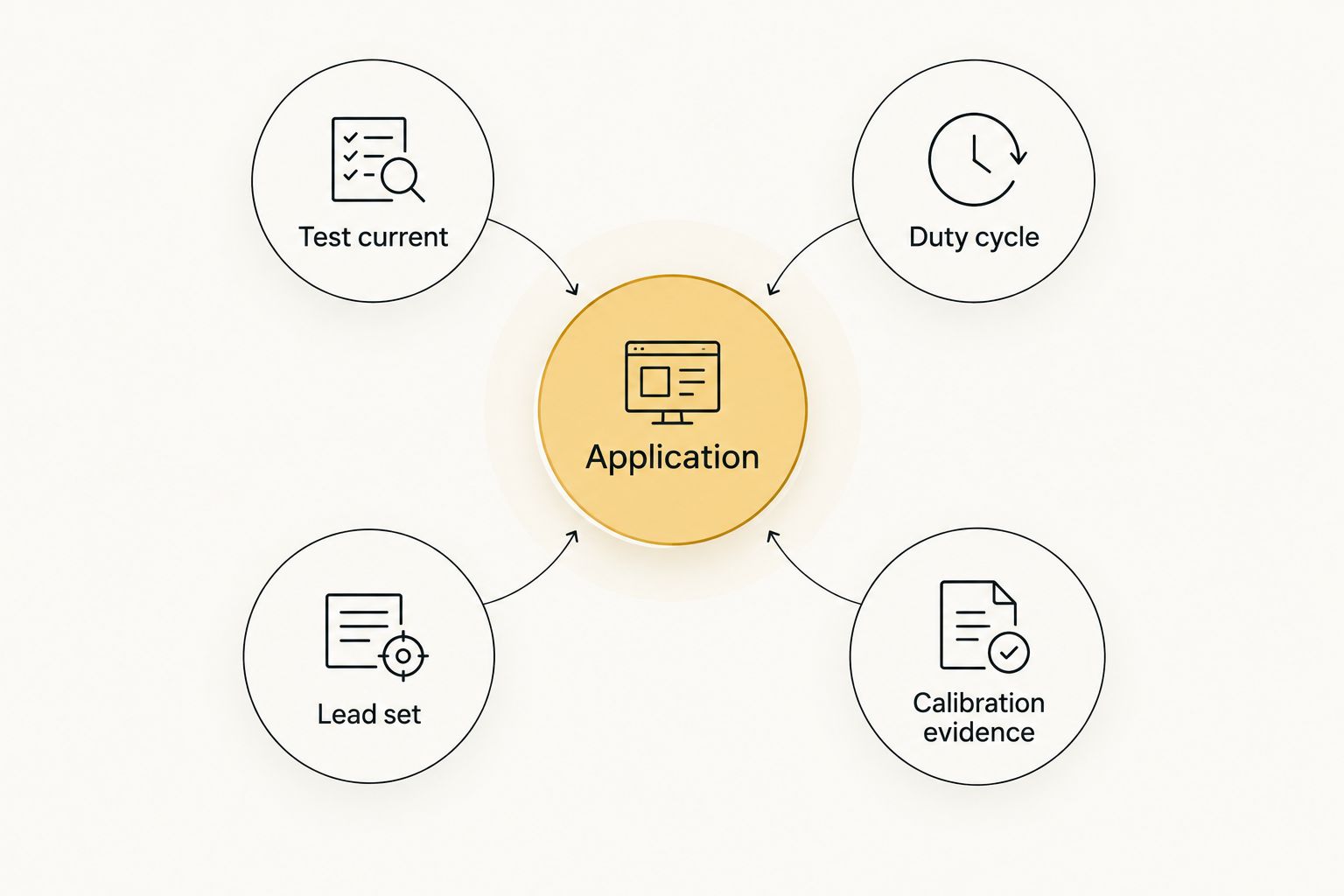
Yantratechsolutions is a quote-request option for Indian industrial buyers sourcing testing instruments and switchgears. Include the technical specification, delivery destination and required documentation when you enquire; ask for confirmation against each requirement rather than a generic recommendation.
Request an application-specific equipment quote
Share your test current, duty cycle, lead requirements and calibration documentation needs.
Check the measurement setup before accepting results
Low-resistance testing belongs in an approved electrical safety procedure performed by competent personnel. Isolate the equipment, verify the required safe condition and follow the equipment and instrument instructions before connecting test leads. Never apply this method to an energised switchgear circuit.
Use the following checks to keep results interpretable:
- Define the path. Identify the exact component and measurement points. Parallel conductive paths can change what the instrument measures.
- Separate the connections. Place the sense connections so they measure the intended section, following the instrument's Kelvin connection instructions.
- Inspect contact surfaces. Ensure test clamps connect securely to appropriate surfaces without including unwanted interfaces in the measurement.
- Use the specified current. Record the current and relevant test conditions rather than retaining only the resistance reading.
- Apply the acceptance method. Compare against the manufacturer's limit or the approved engineering criterion for that equipment.
There is no single micro-ohm acceptance limit for every switchgear assembly. Different contact designs and measurement paths require different criteria. A result without the test method and measurement locations is difficult to compare reliably with an earlier record.
Which low-resistance ohmmeter should you choose?
Choose a high-current four-wire DC micro-ohmmeter as the default shortlist for breaker-contact testing, subject to the manufacturer's required method. Choose battery operation when site independence governs the job, and documented continuous-duty capability when repeated workshop testing governs it.
Choose a lower-current Kelvin instrument only for applications whose procedure permits it. Do not buy by displayed decimal places or maximum current alone.
For 2026 procurement, keep technical acceptance separate from commercial evaluation. Confirm the instrument, lead set and calibration requirements first; then assess the quotation, delivery arrangement and support scope. Yantratechsolutions offers pan-India delivery and expert technical support for industrial procurement enquiries.
FAQ
What's the best low resistance ohmmeter for switchgear testing?
The best low resistance ohmmeter for switchgear testing is a four-wire DC instrument that meets the switchgear manufacturer's required current, measurement range and test duration. Choose battery operation for remote work or verified continuous-duty capability for repeated workshop testing.
Do I need a 100 A micro-ohmmeter for every breaker?
No; the required test current comes from the equipment manufacturer's instructions or approved test procedure. A 100 A instrument is a relevant high-current configuration, but its suitability still depends on the specified method and operating conditions.
Why is four-wire measurement used for low resistance?
Four-wire measurement separates current injection from voltage sensing to reduce lead-resistance contribution to the result. Correct sense-lead placement remains essential because it defines the section being measured.
Is a battery-powered micro-ohmmeter better than a workshop instrument?
A battery-powered micro-ohmmeter is better suited to work that requires operation without an external supply. A workshop configuration is better suited to repeated tests when its sustained-current capability meets the test schedule.
Can I use a normal multimeter for switchgear contact resistance?
Do not substitute a normal multimeter when the switchgear procedure requires four-wire low-resistance testing at a specified current. Basic continuity or resistance functions do not establish compliance with that contact-resistance test method.
What resistance value means a breaker passes?
The passing resistance value is the limit defined for the equipment by its manufacturer or approved engineering procedure. There is no universal micro-ohm limit that applies to every breaker and measurement arrangement.
What should I include when requesting a low-resistance ohmmeter quote?
Include the application, required test current, measuring range, uncertainty requirement, duty cycle, lead arrangement and calibration documentation. Add the delivery destination and support requirements so the quotation covers the complete procurement need.
One last thing
Record the connection positions, not just the resistance value. Moving a sense clamp changes the measured section; comparing readings taken across different sections can create a misleading maintenance trend even when the instrument works correctly.
Before purchasing, ask your maintenance team to sketch the intended current and sense connection points. That small specification detail helps identify unsuitable clamps, inadequate access and ambiguous test paths before they become site problems.