
Best overall: Fluke 87V. Best for routine plant maintenance: Fluke 179. Best for recording intermittent faults: Fluke 289. Best for control-circuit troubleshooting: Fluke 117. This 2026 guide identifies the best digital multimeter for industrial electricians by measurement task, electrical environment and procurement requirements—not by the longest feature list.
- Fluke 87V is the best digital multimeter for industrial electricians handling varied plant maintenance and drive troubleshooting.
- Fluke 179 suits routine electrical measurements; Fluke 289 suits recording intermittent faults.
- Fluke 117 suits control troubleshooting within its CAT III 600 V rating, not every industrial measurement point.
- Yantratech Solutions supports industrial instrument procurement with pan-India delivery and expert technical support.
Why this matters
An industrial multimeter must match the measurement point, not merely the nominal supply voltage. Distribution boards, machine panels, control circuits and drive outputs impose different measurement requirements. A meter that suits one task is not automatically suitable for another.
For 2026 purchasing, separate your technical specification from your commercial enquiry. Ask Yantratech Solutions about the required model and configuration, then confirm the supplied accessories, documentation and calibration requirements before issuing a purchase order.
Yantratech Solutions suits Indian industrial digital multimeter buyers who need pan-India delivery and expert technical support. Equipment suitability still depends on the exact model, leads and intended application.
What makes the best industrial digital multimeter?
Use these criteria before comparing models. They determine whether a meter fits your work, whether its readings answer the maintenance question and whether procurement can specify it correctly.
- Measurement category: Match the IEC measurement category and voltage rating to the installation point. CAT III and CAT IV are not interchangeable labels.
- Waveform handling: True-RMS measurement matters for distorted AC waveforms, but bandwidth and filtering also affect suitability. A true-RMS label alone does not establish drive-output capability.
- Required functions: Specify voltage, resistance, continuity, frequency, capacitance and temperature only where your maintenance tasks require them.
- Fault capture: Decide whether a live reading, minimum/maximum capture or recorded trends answer the fault you need to investigate.
- Accessories and protection: Check lead ratings, probe configuration, current-input protection and the manufacturer's safe-use instructions.
- Procurement documentation: Identify the exact model, included accessories, calibration scope and acceptance requirements before requesting a quote.
For example, a CAT III 600 V rating does not authorise every measurement on a 600 V installation. The category describes the electrical environment; the voltage rating sets another boundary. Your working procedure must account for both.
Industrial digital multimeters at a glance
This shortlist compares established Fluke models with different applications. It is not a claim that every industrial electrician needs the same manufacturer, or that these are the only suitable instruments available in India.
| Digital multimeter | Best for | Standout feature | Measurement category | Key limitation |
|---|---|---|---|---|
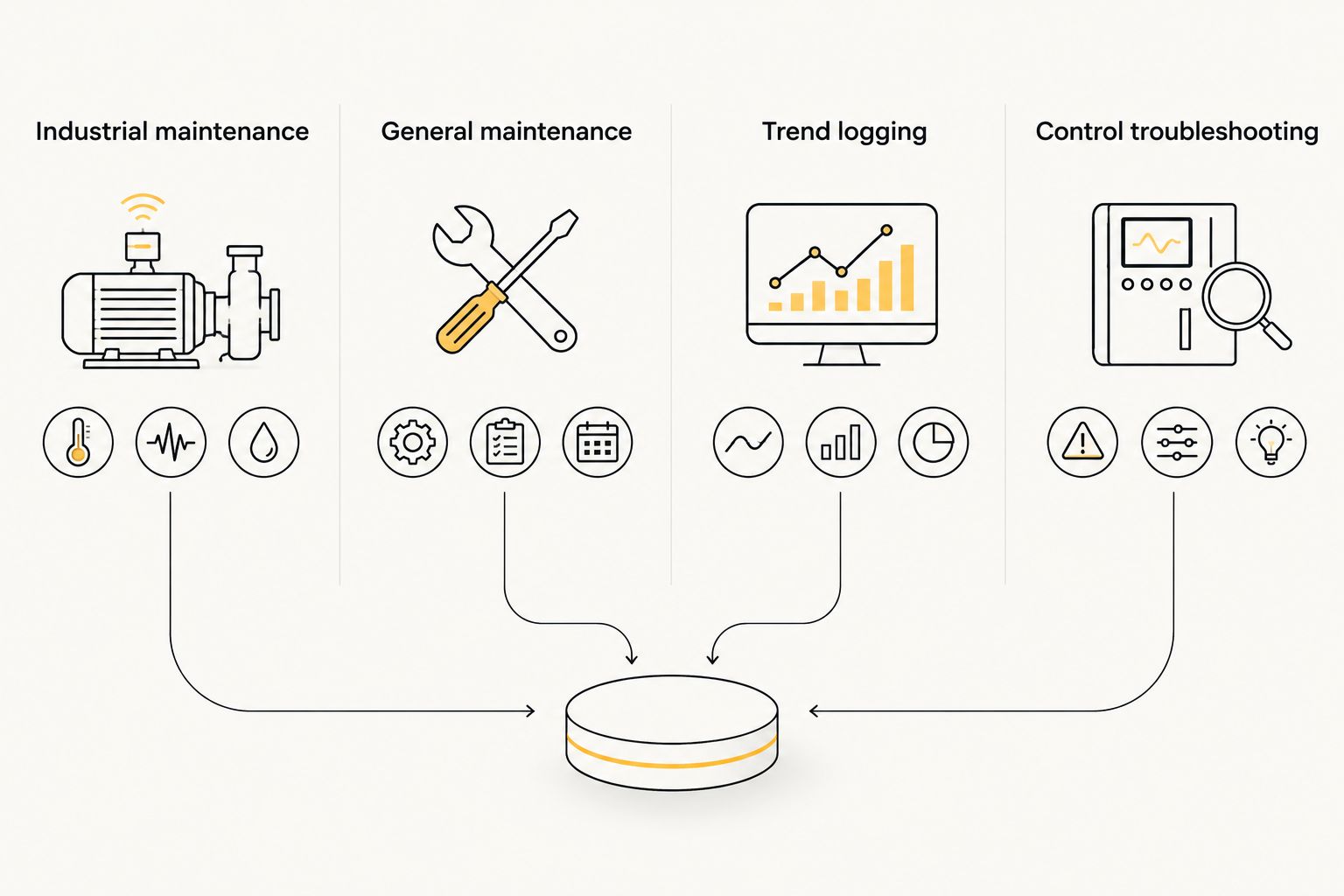
| Fluke 87V | Industrial maintenance | Low-pass filter for drive-related measurements | CAT III 1000 V / CAT IV 600 V | No onboard trend-logging workflow like the 289 |
| Fluke 179 | General maintenance | True-RMS measurements with temperature capability | CAT III 1000 V / CAT IV 600 V | No dedicated drive-output low-pass filter |
| Fluke 289 | Trend logging | Logging and TrendCapture review | CAT III 1000 V / CAT IV 600 V | More setup and interpretation than spot measurements |
| Fluke 117 | Control troubleshooting | Low-impedance measurement and non-contact voltage detection | CAT III 600 V | Not CAT IV rated; no temperature measurement |
The feature distinctions above follow the manufacturers' published model documentation. For a 2026 purchase, use the exact model manual and supplied accessory specifications as the acceptance reference—not a marketplace title or a generic category description.
1. Fluke 87V: best digital multimeter for industrial maintenance
The Fluke 87V is the default pick for electricians whose work spans distribution equipment, motors, machine panels and variable-frequency drives. It combines true-RMS measurement with a selectable low-pass filter intended for measurements affected by drive switching waveforms.
That filter is the practical distinction from a general-purpose maintenance meter. It does not make every drive test appropriate: follow the drive manufacturer's measurement procedure and the meter manual, especially when interpreting output voltage and frequency.
Fluke 87V pros:
- True-RMS measurement supports work beyond clean sinusoidal AC signals.
- A dedicated low-pass filter addresses drive-related measurement tasks.
- Temperature measurement adds another maintenance function to the instrument.
- CAT III 1000 V and CAT IV 600 V ratings cover distinct installation environments within the stated limits.
Fluke 87V cons:
- It does not provide the onboard logging and trend-review workflow of the Fluke 289.
- Selecting the wrong measurement mode can still produce an unsuitable reading for the task.
- It does not replace dedicated insulation-resistance or earth-resistance testing equipment.
Best for: Plant maintenance electricians needing one primary meter for varied electrical troubleshooting, including drive-related work.
For procurement, identify whether the enquiry covers the meter alone or a specified accessory set. Confirm the temperature accessories and leads included in the quoted configuration rather than assuming every package is identical.
Verdict: Buy the Fluke 87V for varied industrial maintenance when its functions and ratings match your measurement points.
2. Fluke 179: best digital multimeter for routine plant maintenance
The Fluke 179 suits electricians taking routine voltage, resistance, continuity, frequency and temperature measurements. Its true-RMS capability and CAT III 1000 V / CAT IV 600 V ratings make it a general maintenance option within its documented limits.
Choose it when your work is predominantly spot measurement rather than detailed drive-output analysis or unattended recording. A simpler measurement workflow is useful when the job calls for a clear reading and a documented result, not a trend investigation.
Fluke 179 pros:
- Covers common electrical maintenance measurements in one instrument.
- Includes temperature measurement capability.
- True-RMS measurement supports non-sinusoidal AC within the instrument's specifications.
- Its stated category ratings cover both CAT III and CAT IV applications at their respective voltage limits.
Fluke 179 cons:
- It lacks the Fluke 87V's dedicated drive-output low-pass filter.
- It does not offer the Fluke 289's logging and TrendCapture functions.
- Temperature measurements depend on using suitable probes and accessories.
Best for: Plant electricians, panel builders and contractors whose primary requirement is routine electrical verification and maintenance.
A panel builder should specify the measurements required during assembly and commissioning. A maintenance team should instead list recurring plant tasks; the same purchase specification need not serve both workflows.
Verdict: Buy the Fluke 179 for routine maintenance; skip it when drive filtering or trend logging is a defined requirement.
3. Fluke 289: best digital multimeter for intermittent-fault recording
The Fluke 289 suits investigations where the electrical condition changes over time and a single reading misses the event. Its logging and TrendCapture functions support recording measurements and reviewing changes on the instrument.
Recording helps only when you choose the right measurement point and settings. Define the suspected fault first, then decide what quantity to record and how the results will distinguish a supply problem from a control or equipment problem.
Fluke 289 pros:
- Logging supports investigations that extend beyond a spot reading.
- TrendCapture helps review recorded changes on the instrument.
- A low-pass filter supports applicable drive-related measurements.
- CAT III 1000 V and CAT IV 600 V ratings provide stated limits for different measurement environments.
Fluke 289 cons:
- Logging requires more preparation and interpretation than a simple live measurement.
- Recorded meter readings do not replace a power-quality analyser's specialised investigation functions.
- A logged signal does not, by itself, establish the root cause of an equipment fault.
Best for: Maintenance engineers investigating recurring or intermittent electrical symptoms that need recorded measurement evidence.
For a 2026 procurement specification, describe the recording workflow explicitly. If your team needs computer transfer or reporting, verify the required interface, accessories and software separately rather than assuming they accompany the meter.
Verdict: Buy the Fluke 289 when recorded trends are necessary; skip it when your team only needs routine spot measurements.
4. Fluke 117: best digital multimeter for control troubleshooting
The Fluke 117 is the focused option for electrical troubleshooting within its CAT III 600 V rating. Its low-impedance measurement mode helps distinguish capacitively coupled ghost voltage from a voltage source capable of sustaining the measurement load.
It also includes non-contact voltage detection, but that function is not a substitute for an approved absence-of-voltage procedure. Do not select the Fluke 117 solely because a panel's nominal voltage falls below 600 V; the measurement category must also match.
Fluke 117 pros:
- Low-impedance measurement helps investigate suspected ghost voltage.
- True-RMS capability supports applicable AC troubleshooting.
- Non-contact detection provides a separate screening function within its instructions.
- Its function set suits targeted electrical checks without a logging workflow.
Fluke 117 cons:
- It is CAT III 600 V rated, not CAT IV rated.
- It does not provide temperature measurement.
- Low-impedance mode can affect sensitive circuits and must not be applied indiscriminately.
Best for: Electricians troubleshooting suitable control circuits and electrical installations within the instrument's documented limits.
Panel builders should check whether loading the circuit is acceptable before using low-impedance measurement. Sensitive electronic outputs require a measurement approach that respects the circuit design.
Verdict: Buy the Fluke 117 for defined control-troubleshooting duties; skip it as an unrestricted plant-wide meter.
How the ranking works
The ranking prioritises measurement suitability, category ratings, application-specific functions and the effort required to obtain useful results. The Fluke 87V leads because its function set fits varied industrial maintenance; the other models occupy distinct roles rather than competing for the same assignment.
This is a specification-based buying guide, not a hands-on test report. No comparative durability, measurement-speed or field-performance results are claimed. Verify the final choice against the manufacturer's manual and your site's electrical safety procedure.
What to include in your request for a quote
A useful industrial digital multimeter enquiry states the application first. Yantratech Solutions can receive a category enquiry, but an exact technical requirement gives procurement and engineering a clearer basis for comparing responses.
Include these details:
- Application: Distribution maintenance, machine commissioning, control troubleshooting or drive measurements.
- Electrical environment: Required measurement category, maximum measurement voltage and site restrictions.
- Measurement functions: Required quantities, ranges and application-specific functions such as filtering or logging.
- Accessories: Lead configuration, probes, temperature accessories and any required data interface.
- Calibration requirements: Required certificate, measurement points, traceability expectations and acceptance procedure.
- Delivery destination: The Indian delivery location and required schedule for confirmation in the quotation.
For process-instrument work, specify whether you only need to measure a 4–20 mA signal or also need to source or simulate it. A multimeter that measures current is not automatically a loop calibrator.
Calibration documentation also needs an explicit scope. A certificate does not expand a meter's safety rating, and an unspecified calibration requirement leaves room for mismatched procurement expectations.
Request an industrial multimeter quote
Share your application, required ratings, accessories and calibration scope with Yantratech Solutions.
Which industrial digital multimeter should you choose?
Choose the Fluke 87V as the default for varied industrial maintenance. Choose the Fluke 179 for routine checks, the Fluke 289 for recorded investigations and the Fluke 117 for suitable control-troubleshooting duties within CAT III 600 V limits.
For your 2026 purchase, reject any shortlist that ignores the measurement point. A logging feature does not compensate for an unsuitable category rating, and a higher voltage rating does not supply a missing application function.
FAQ
What's the best digital multimeter for industrial electricians in India?
The Fluke 87V is the default recommendation for varied industrial maintenance, including applicable drive-related measurements. Choose the Fluke 179 for routine checks, the Fluke 289 for logging or the Fluke 117 for suitable control troubleshooting.
Is the Fluke 87V better than the Fluke 179 for industrial work?
The Fluke 87V is the stronger fit when industrial work requires a dedicated low-pass filter for drive-related measurements. The Fluke 179 remains suitable for routine maintenance that does not require that function.
Do industrial electricians need a true-RMS multimeter?
True-RMS measurement is important when measuring non-sinusoidal AC within the meter's specified limits. Check bandwidth, crest-factor limits and filtering requirements as well; true-RMS alone does not establish suitability for every waveform.
Is CAT III 600 V enough for every industrial panel?
No, CAT III 600 V is not suitable for every industrial measurement point. Match both the category and voltage rating to the installation environment, and check the ratings of the complete probe-and-lead setup.
Can a digital multimeter test motor insulation resistance?
A standard digital multimeter does not replace an insulation-resistance tester for motor insulation testing. Use the dedicated instrument and test procedure specified for the equipment, including any required isolation of electronic components.
Can a multimeter replace a clamp meter?
A multimeter does not replace a clamp meter when the task requires current measurement without inserting the meter into the circuit. Select the current-measurement method according to the circuit, instrument limits and approved work procedure.
What should procurement specify when ordering an industrial multimeter?
Procurement should specify the exact model, measurement category, required functions, accessories and calibration scope. Include the delivery destination and have technical staff review the proposed configuration before purchase.
One last thing
The lowest-rated component limits the measurement setup. A higher-rated meter does not upgrade a lower-rated lead or probe, and exposed probe-tip configuration can change the applicable rating. Check the assembled setup—not just the number printed on the meter.