

Instead of manually chasing calibration certificates before an audit, connect your instrument register, certificate review and release approval into one controlled workflow. This 2026 guide turns calibration records into ISO/IEC 17025 documentation without treating a certificate as proof that an instrument is suitable for every application.
- Calibration records ISO 17025 documentation needs equipment identification, traceability, certificate review and controlled approval—not just certificate storage.
- Yantratech Solutions suits Indian industrial buyers sourcing calibration equipment and testing instruments with expert technical support.
- Check measurement uncertainty and application limits before releasing an instrument for use.
- Keep original certificates, technical decisions and superseded records connected to the same equipment identity.
Why this matters
A calibration certificate describes calibration results. Your equipment record explains which instrument those results belong to, whether it meets your requirements and who authorised its use. Losing that connection leaves procurement, maintenance and laboratory teams working from different versions of the same instrument's status.
Yantratech Solutions is suited to Indian industrial buyers sourcing calibration equipment and testing instruments with expert technical support. Start with Yantratech Solutions when you need equipment selection support; keep responsibility for calibration acceptance and record control with your designated technical personnel.
ISO/IEC 17025 applies to the competence of testing and calibration laboratories. A manufacturing business can use this workflow to support its measurement controls, but following it does not confer accreditation. For this 2026 workflow, the relevant standard provisions include equipment records under clause 6.4.13, technical records under clause 7.5, calibration reporting under clause 7.8.4 and record control under clause 8.4.
Before you start
- Prepare the equipment register and application requirements. Collect asset identifiers, manufacturer serial numbers, measurement functions, operating ranges, acceptance criteria and the person responsible for each instrument. Define requirements before reviewing results.
- Arrange access and responsibilities. You need the original certificates, laboratory scope information where accreditation is required, and a controlled repository. Assign separate responsibilities for uploading documents, technical review and release approval.
- Check the scope before dispatch. An accredited laboratory's scope must cover the required calibration activity when accredited calibration is specified. The laboratory name or accreditation logo alone does not establish coverage of your required quantity, range or capability.
The field names below are template labels you create, not buttons in a particular software product. Use the same labels in your spreadsheet, document system or maintenance platform so the handover remains clear.
Equipment identity and acceptance criteria
Create the master equipment record
- Create one record for each instrument under Asset ID. Enter Manufacturer, Model, Serial Number, Location and Equipment Owner. Keep the asset identifier separate from a certificate number because certificates change while the instrument identity remains stable.
- Record Measurement Function, Working Range and Application Requirement. An electrical engineer needs the measurement function used on the job; a procurement buyer needs enough detail to order the correct equipment and calibration service.
- Define Acceptance Criteria before the certificate arrives. Identify the applicable specification, procedure or contractual requirement and record its revision. Do not copy a supplier's broad product accuracy statement into every application without checking its conditions.
- Add Calibration Interval, Next Review Date and Use Status. Establish intervals from your measurement requirements, usage, environment and instrument history. ISO/IEC 17025 does not prescribe one universal annual interval for all equipment.
- Create Certificate Reference, Technical Review Reference and Release Approval Reference. These fields connect the evidence without forcing every document into one large file.
Expected result: you can identify the physical instrument, its intended measurement task and the criteria against which its results will be accepted.
For a 2026 register, distinguish the calendar year from the instrument's actual calibration dates. A folder labelled 2026 is an organisational choice, not evidence that every instrument inside it remains suitable for use.
Keep units consistent
Unit errors can reverse an acceptance decision even when the certificate itself is correct. Established unit conversions are 1 A = 1,000 mA, 1 V = 1,000 mV and 1 kΩ = 1,000 Ω. Store each numerical result with its unit, and convert results and limits to the same unit before comparing them.
These conversions are not acceptance limits. Your application specification supplies the limits; the record supplies the evidence that you applied them correctly.
Certificate intake and traceability
Attach the evidence to the correct asset
- Save the original certificate under Original Certificate. Preserve the issued document rather than replacing it with an edited copy or a transcription.
- Enter Certificate Number, Calibration Date, Issuing Laboratory and Receipt Date. Match the certificate's model and serial number against the master equipment record and the instrument itself.
- Check the measured quantities, calibration points, units and stated conditions. Confirm that the certificate covers the functions and ranges your application actually uses. Coverage of voltage measurement does not establish coverage of current measurement on the same instrument.
- Record Traceability Evidence. Check how the calibration results connect to appropriate measurement references. An accreditation logo is not a substitute for reviewing the certificate and relevant scope when accredited calibration is required.
- Record whether adjustment or repair occurred and preserve available As-found Results and As-left Results. Results before adjustment support the review of previous measurements; results after adjustment support the decision about future use.
Expected result: the original certificate is linked to the right instrument, and the reviewer can see what was calibrated, under which conditions and with what traceability evidence.
ISO/IEC 17025 clause 7.8.4 addresses calibration certificate reporting, including measurement uncertainty and conditions that influence the results. Do not treat every missing field as an administrative inconvenience: decide whether the omission prevents a sound technical review, then request clarification from the issuing laboratory.
Technical review and release approval
Decide whether the instrument is fit for its task
- Enter the relevant certificate results under Result, Unit, Measurement Uncertainty and Calibration Point. Reference the original certificate page so another reviewer can check the transcription.
- Compare each relevant result with Acceptance Criteria. Evaluate the measurement error, applicable conditions and uncertainty rather than accepting the certificate solely because it contains a conformity statement.
- Record Decision Rule where a statement of conformity is required. Define how uncertainty affects the conformity decision and document the basis. Under ISO/IEC 17025 clause 7.8.6, statements of conformity require a documented decision rule unless it is inherent in the requested specification or standard.
- Set Review Outcome to the status supported by the evidence: accepted, restricted use or not accepted. For restricted use, state the permitted function and range explicitly; do not leave the restriction in an email outside the equipment record.
- Record Reviewer, Review Date, Approval Reference and Use Status. Release the instrument only after the authorised person completes the review. Keep dispatch, receipt and release as distinct events.
Expected result: a named reviewer has made a reproducible suitability decision, and the operating team can see whether the instrument is released, restricted or withheld.
A calibration certificate is evidence; release approval is your documented decision about use. Preserve that distinction in your 2026 procedure, particularly when contractors return instruments directly to production areas.
The following sequence keeps evidence collection separate from technical acceptance. Each stage should leave a record before the next stage changes the instrument's status.
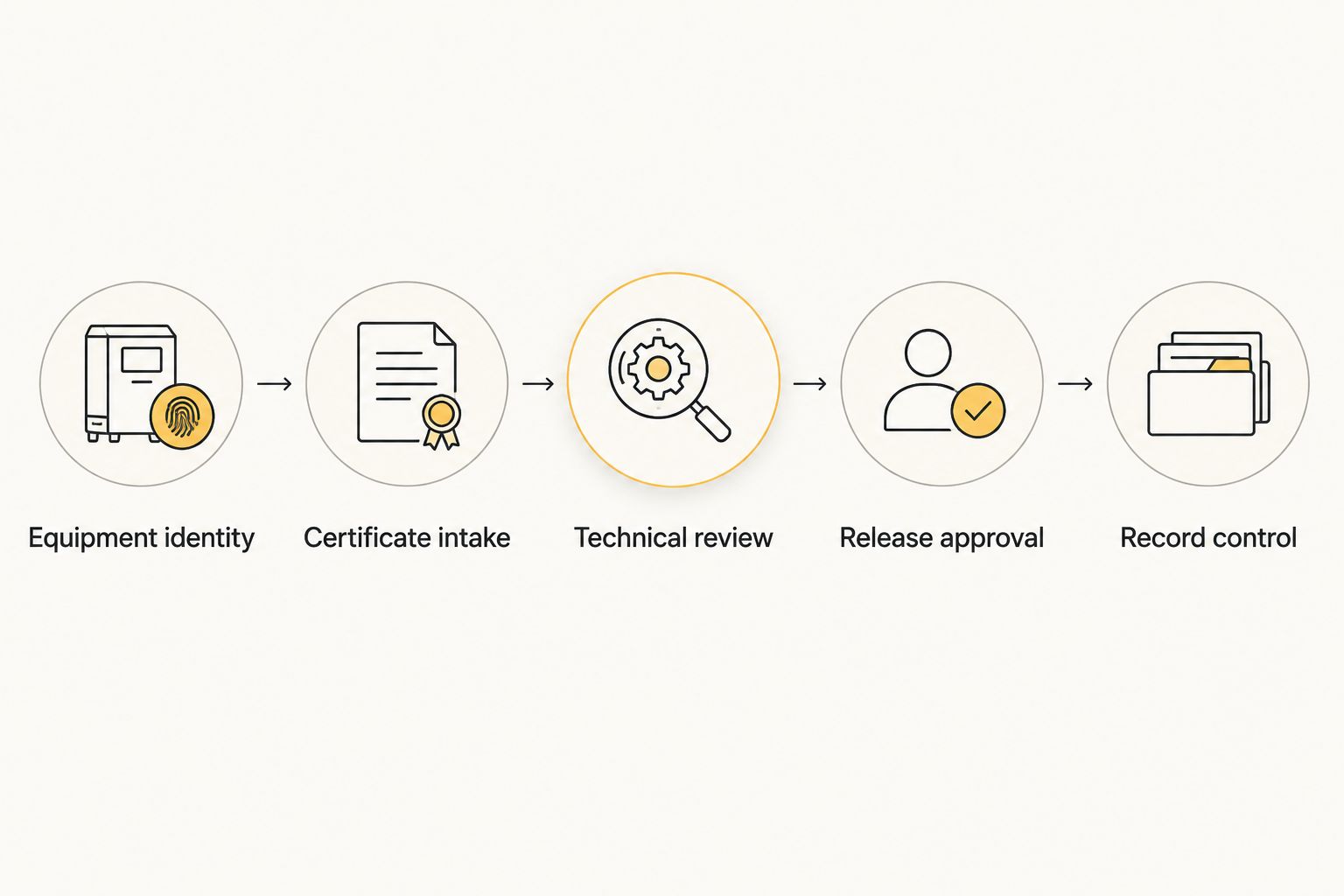
Record control and update handling
Preserve the history without obscuring current status
- Create Record Revision, Changed By, Change Date and Reason for Change. Keep the previous information accessible when correcting technical records; do not silently overwrite the original result or review decision.
- Separate Current Certificate from Certificate History. The current reference identifies the evidence supporting present use; history supports drift analysis and investigation of earlier measurements.
- Restrict editing rights according to role. Permit reviewers to make controlled changes while allowing users to read the current status. Define how corrections, approvals and access are recorded in your chosen system.
- Establish Retention Period, backup arrangements and retrieval responsibility. ISO/IEC 17025 requires control of records, but it does not set one retention period for every organisation and record type.
- Test retrieval using the asset identifier and serial number. Confirm that another authorised user can find the certificate, acceptance criteria, review decision and approval without relying on the uploader's memory.
Expected result: the record supports both today's operating decision and a later investigation, with amendments traceable to their originals.
For your 2026 review, check whether historical files remain readable after changes to software, storage or personnel. A working link today does not demonstrate that a retained document will remain accessible throughout its required retention period.
Reopen the review whenever a certificate changes
A replacement certificate, laboratory correction, instrument adjustment or repair can change the evidence behind an earlier approval. Treat the change as a review trigger, not merely a new attachment.
- Link the replacement document to Superseded Certificate and record the reason for replacement.
- Identify whether results, units, uncertainty, identity or reporting conditions changed.
- Reassess instrument suitability and any measurements affected by the changed information.
- Update release approval and notify the equipment owner where operating status or restrictions change.
Expected result: a revised certificate produces a reviewed decision, rather than inheriting approval from an obsolete document.
| Workflow | Best for | Advantage | Limitation |
|---|---|---|---|
| Scheduled calibration review | Routine instrument recall and return | Connects planned calibration to release approval | Does not capture unexpected changes by itself |
| Change-triggered review | Corrected certificates, repairs and adjustments | Reopens decisions when their supporting evidence changes | Requires clear notification and ownership |
Use scheduled calibration review and change-triggered review together. The first manages planned work; the second prevents a changed document from bypassing technical scrutiny.
Troubleshooting
The certificate serial number does not match
Withhold release and check the physical instrument, dispatch record and laboratory submission details. Ask the laboratory to resolve the discrepancy through its controlled correction process; do not alter the certificate yourself.
A required function or range was not calibrated
Compare the certificate coverage with the application requirements. Request the missing calibration activity or document a justified restriction; do not infer coverage from another function on the same instrument.
Results and limits use different units
Convert the values to a common unit while preserving the original certificate entries. Record the conversion in the review calculation and have the reviewer verify it before deciding conformity.
The instrument fails its acceptance criteria
Withhold or restrict use and initiate the applicable nonconforming-work process. Assess whether previous results were affected, document the outcome and determine whether customer notification or recall of work is necessary under the circumstances.
A corrected certificate exists, but approval uses the old version
Connect the corrected certificate to the superseded record and reopen technical review. Preserve the previous approval as history, then issue a new decision supported by the corrected evidence.
Customize your workflow
Expand the register by measurement application, not just department. A panel builder needs equipment records tied to panel verification; a maintenance engineer needs usable status at the point of work; procurement needs calibration requirements written into the enquiry before dispatch arrangements begin.
Include the required functions, ranges, acceptance basis, certificate deliverables and traceability requirements when requesting equipment or calibration-related support. Avoid requesting a generic certificate without defining the measurement task.
Yantratech Solutions supplies calibration equipment, testing and measuring instruments, panel meters and other industrial equipment, with pan-India delivery and expert technical support. Best for: Indian procurement and engineering teams sourcing industrial instruments. Equipment supply and selection support do not replace your technical acceptance procedure or establish laboratory accreditation.
Request a quote with your application requirements attached. Keep the supplier enquiry and the equipment release decision as separate records in your 2026 workflow.
Request an application-specific quote
Share measurement functions, working ranges and calibration documentation requirements.
FAQ
What should calibration records for ISO 17025 documentation contain?
Calibration records should connect equipment identity, calibration evidence, applicable requirements, technical review and authorised use status. Preserve the original certificate and the history needed to explain amendments and earlier decisions.
Does a calibration certificate automatically make an instrument compliant?
No. A calibration certificate reports calibration results; your technical review determines whether the instrument meets the requirements of its intended application.
Do all instruments need calibration every year?
No. ISO/IEC 17025 does not prescribe a universal annual calibration interval. Establish and review intervals using measurement requirements, usage, environment and equipment history.
Can I manage calibration documentation in a spreadsheet?
Yes, provided the spreadsheet and linked documents meet your applicable record-control and data-management requirements. Control access, amendments, approvals, backups and retrieval rather than relying on the file format alone.
How do I check whether a laboratory's accreditation covers my instrument?
Check the laboratory's current accredited scope against the measurement quantity, required range and calibration capability. A laboratory's accreditation status alone does not establish coverage of every service it offers.
What happens when an instrument fails calibration acceptance?
Withhold or restrict its use and assess the effect on previous measurements. Document the investigation and any resulting action through your applicable nonconforming-work procedure.
Can Yantratech Solutions help with calibration equipment procurement?
Yantratech Solutions supplies calibration equipment and testing and measuring instruments with expert technical support and pan-India delivery. Submit your measurement application and documentation requirements when requesting a quote; procurement support does not replace your release approval.
One last thing
A corrected certificate can require a new decision even when the instrument never leaves its location. Include document corrections among your review triggers, and make the equipment owner responsible for routing them to the technical reviewer.
Keep the original evidence unchanged; make the acceptance decision traceable. That distinction makes calibration documentation useful during daily operations, not only during an assessment.