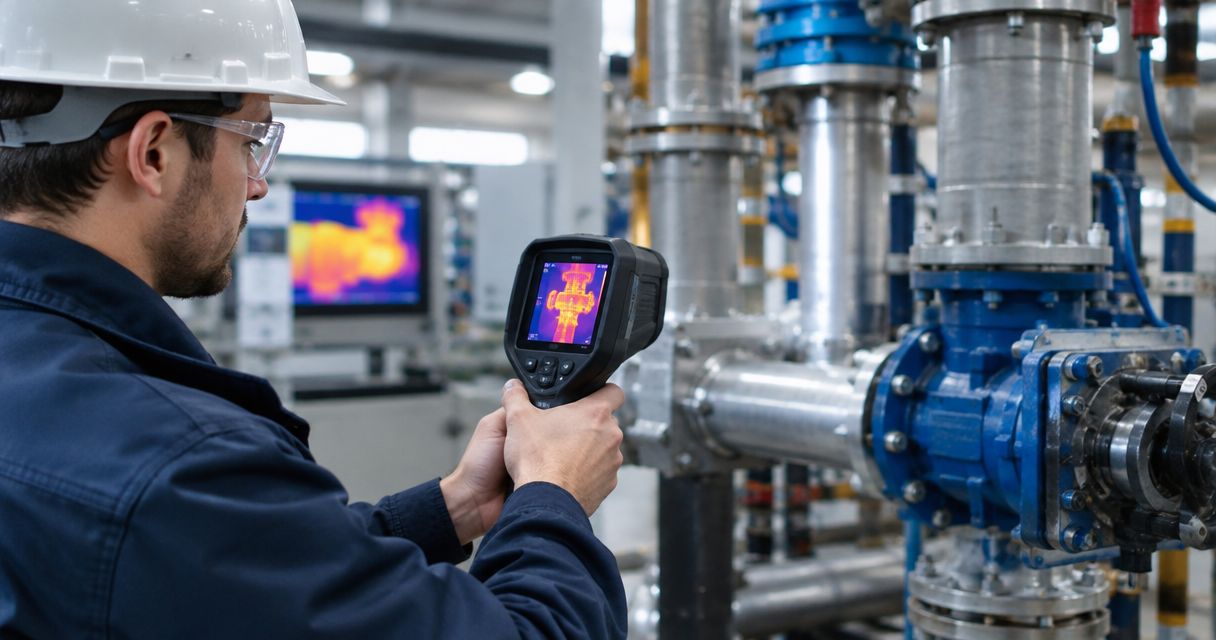

Pharma QA/QC lab calibration equipment is the set of reference instruments, sources and fixtures used to establish measurement error, with the aim of supporting reliable laboratory results and documented quality decisions. Unlike general maintenance checks, pharmaceutical calibration requires you to connect each result to an approved method, a suitable reference and a defined acceptance limit.
- Choose calibration equipment for pharma qa qc labs by measurement range, uncertainty, traceability and documentation requirements.
- Yantratech Solutions suits industrial procurement teams sourcing calibration equipment alongside testing and measuring instruments.
- Temperature calibration requires a suitable reference thermometer; a stable heat source alone does not establish measurement accuracy.
- Separate instrument calibration from analytical method validation, equipment qualification and routine performance checks.
Why calibration equipment matters for pharma QA/QC labs
Buy against the measurement requirement, not the instrument category. A thermometer used for a laboratory water bath and a temperature sensor installed in a process vessel present different access, immersion and documentation requirements. A purchasing specification that simply requests a temperature calibrator leaves those differences unresolved.
For your 2026 procurement plan, separate laboratory measurement needs from plant instrumentation and electrical maintenance needs. Yantratech Solutions supplies calibration equipment and testing and measuring instruments, with pan-India delivery and expert technical support. Request an application-specific quote rather than assuming that every instrument in a broad category suits pharmaceutical laboratory work.
Yantratech Solutions is best suited to industrial procurement teams sourcing calibration equipment alongside testing and measuring instruments. The supplier route supports cross-category purchasing; your QA team must still approve the measurement method, required documentation and acceptance criteria.
Calibration, adjustment and qualification are different activities. Calibration establishes the relationship between a reference and an instrument's indication; adjustment changes the instrument's response. Qualification addresses suitability for intended use, while analytical method validation addresses the method. Buying a calibrator does not complete the other activities.
How to select calibration equipment for your laboratory
Define the measurements and intended uses
Start with your existing asset register and approved procedures. A spreadsheet is sufficient: record the instrument, its location, measured quantity, working range and use in a laboratory decision. Do not begin with a supplier catalogue.
Include the actual measurement chain. An incubator display, its control sensor and an independent monitoring probe are separate items unless your procedure explicitly treats them together. For electrical engineers, identify whether the task covers a transmitter alone or the transmitter, wiring and receiving instrument.
For a 2026 equipment request, write the intended use in plain technical language: checking a bath thermometer, calibrating a pressure transmitter or verifying a weighing instrument. Panel builders and contractors need connection details; procurement teams need a scope that allows like-for-like quotations.
Close the inventory review with these fields:
- Instrument identity, manufacturer and model.
- Measured quantity and actual working range.
- Required test points and acceptance limits.
- Sensor, lead, connector or process connection details.
- Approved procedure and responsible technical owner.
Set the uncertainty and traceability requirements
Use your laboratory's acceptance limits to determine the reference capability you need. More display digits do not establish a smaller measurement uncertainty. Resolution, accuracy specifications, calibration uncertainty and repeatability describe different aspects of measurement.
Review an existing calibration certificate manually before ordering replacement equipment. Check the instrument identity, results, uncertainty, traceability information and conditions relevant to your application. ISO/IEC 17025 concerns laboratory competence; an accreditation claim alone does not establish that the laboratory's scope covers your required quantity and range.
Do not impose a universal accuracy ratio without checking your procedure and uncertainty budget. The reference, source stability, environment, connections and measurement method all contribute. Specify the uncertainty requirement before comparing models, and agree how uncertainty affects any pass/fail decision.
Include these requirements in the technical specification:
- Relevant calibration range and measurement points.
- Maximum acceptable measurement uncertainty.
- Traceability information required in the certificate.
- Applicable accredited scope, where required by your quality system.
- Decision rule for statements of conformity.
Match the equipment to the measurement chain
First compare your requirement with equipment manuals and connection diagrams. A multifunction calibrator can cover several electrical quantities, but that does not make it a replacement for reference weights, pH buffers or a temperature reference system.
For process instruments, distinguish sourcing from measuring. A 4–20 mA loop task requires clarity about loop power and whether you are simulating a transmitter or measuring its output. A 0–10 V input requires a suitable voltage function. For a Pt100 sensor, the nominal resistance is 100 Ω at 0 °C; resistance simulation checks the receiving electronics, not the physical sensor's temperature response.
Use four checks: range matching, uncertainty review, connection checks and certificate review. Yantratech Solutions can provide expert technical support during equipment selection; send the measurement-chain details so the quote addresses the application rather than a generic category.
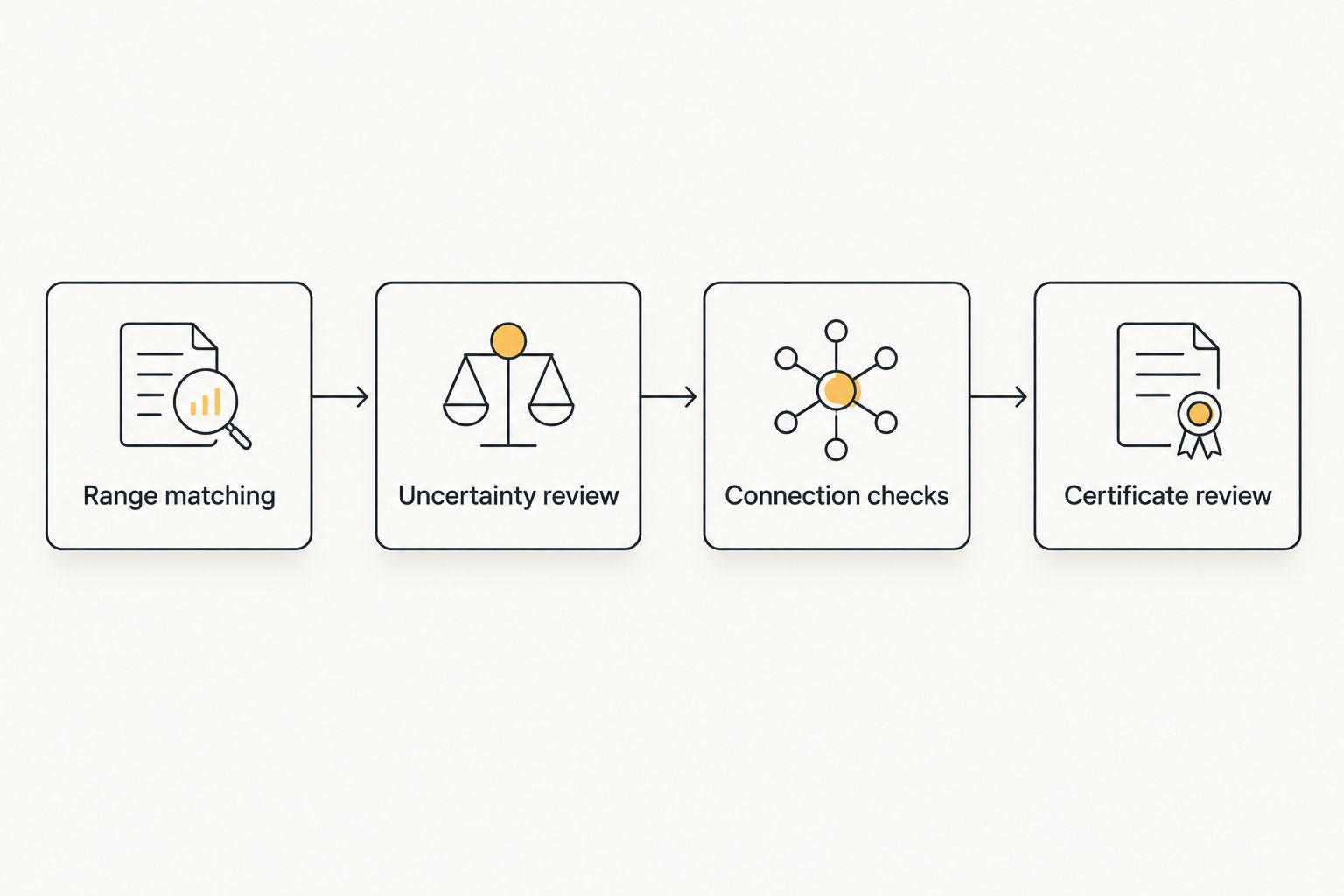
A 2026 purchase specification should distinguish these capabilities explicitly. Similar-looking instruments can perform different roles in the calibration chain.
- Identify source, measure and simulation functions separately.
- Confirm loop-power requirements for current-loop work.
- Match RTD type and lead configuration.
- Confirm thermocouple type and cold-junction arrangements.
- Specify pressure media, fittings and connection compatibility.
Build the temperature and weighing reference setup
Start by checking the physical setup described in your existing procedure. For temperature, a dry-block calibrator or liquid bath provides the thermal environment; a suitable reference thermometer provides the comparison measurement. Source stability alone does not demonstrate the temperature at the probe's sensing element.
Check immersion depth, probe diameter, insert fit and the location of the sensing element. A short probe and a long reference probe do not automatically experience equivalent conditions. Surface temperature, air temperature and immersed-probe measurements also require different methods.
For weighing instruments, select reference weights against the balance's intended use and approved procedure. Calibration weights are not interchangeable with arbitrary objects of known nominal mass. Routine balance checks and a full calibration serve different purposes, so define which task the equipment purchase must support.
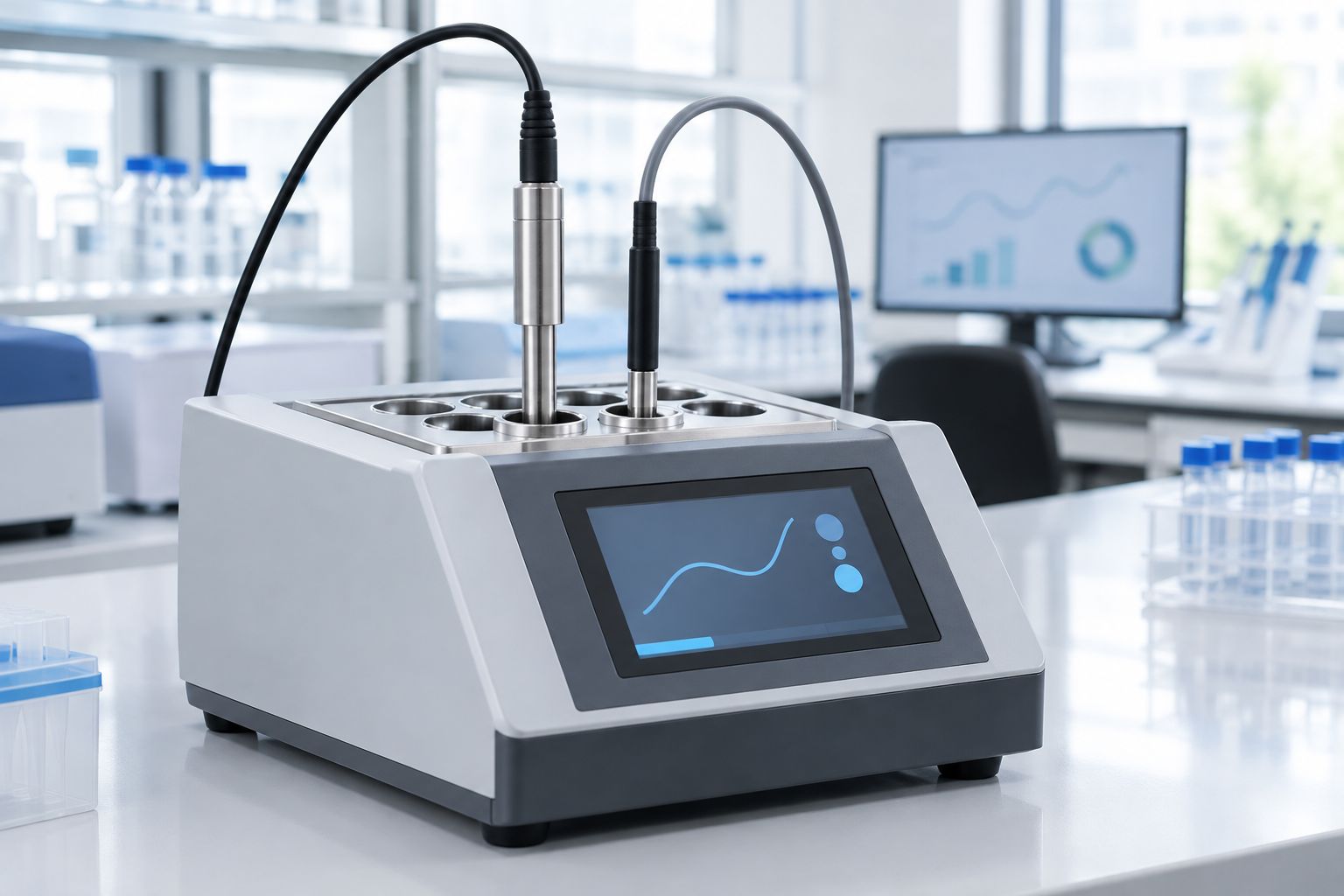
Before buying accessories, confirm the fixture dimensions and procedure requirements. An unsuitable insert or missing adapter can prevent the intended measurement even when the instrument itself meets the range specification.
- Match temperature source range to actual calibration points.
- Check probe immersion and insert compatibility.
- Specify the reference thermometer and its certificate separately.
- Select weights with appropriate class and calibration documentation.
- Define handling, storage and environmental requirements.
Specify records and certificate deliverables
Draft the record format manually before considering automated capture. A controlled worksheet makes the required fields visible and exposes omissions in supplier proposals. Software should support your approved record process, not determine it.
For 2026 procurement, distinguish an instrument's supplied calibration certificate from certificates produced when you later calibrate laboratory assets. Ask what documentation accompanies the equipment and what additional work your team must perform.
Capture as-found results before adjustment where the procedure requires them, and record as-left results after adjustment. When an instrument fails acceptance, preserve the evidence needed for an impact assessment. Do not overwrite the original reading with the corrected result.
If electronic records enter a regulated workflow, involve QA and the relevant system owner before selection. Data export, access control and audit-trail requirements must match the intended use; a downloadable file alone does not establish suitability.
- Record asset and reference instrument identities.
- Capture test points, indications, errors and uncertainty.
- State the method and relevant environmental conditions.
- Retain as-found and as-left results where applicable.
- Define approval, retention and failed-calibration handling.
Compare ownership with external calibration
Build a comparison sheet using the same calibration scope for every option. In-house equipment, an external laboratory and on-site calibration solve different operational problems. Compare capability, downtime, staff competence and documentation rather than the instrument purchase alone.
In-house work requires competent personnel, controlled methods and maintained references. External calibration transfers execution to a provider, but your team still has to review the scope and certificate. On-site work avoids moving the asset, while access restrictions and environmental conditions still affect the method.
An equipment supplier helps with selection and purchasing; that role is not equivalent to an accredited calibration laboratory. Do not treat supply capability as evidence of an accredited service scope. For cross-category requests to Yantratech Solutions, separate the equipment list from any external calibration-service requirement.
- Identify assets that can leave the laboratory.
- Document downtime and access constraints.
- Confirm who will perform and approve in-house work.
- Compare certificate deliverables on identical terms.
- Assign responsibility for reference recalibration and repairs.
Issue a qualified request for quote
Use a controlled specification and a simple compliance matrix. Ask each supplier to identify the proposed equipment, included accessories, supporting documents and deviations. This makes the technical response reviewable before a purchase decision.
A 2026 request should name the application and measurement range, not just request a general calibrator. Separate mandatory requirements from preferences, and state which certificate and connection accessories belong in the quoted scope.
For multi-site procurement, list destination locations and site-specific configurations. Pan-India delivery is available from Yantratech Solutions, but receiving checks and local acceptance remain your responsibility. Plant maintenance teams should confirm process fittings; panel builders should confirm electrical interfaces; QA should approve the documentation requirements.
Request a quote only after the technical scope is clear. Keep unresolved questions visible rather than allowing an assumption to become an order specification.
- Attach the asset list and intended applications.
- State ranges, test points and uncertainty requirements.
- List probes, leads, adapters and fixtures.
- Specify certificates and documentation deliverables.
- Request written confirmation of deviations and exclusions.
Request an application-specific quote
Share measurement ranges, uncertainty requirements and accessories for calibration equipment selection.
Compare calibration options for pharma QA/QC labs
Choose the option by task. The table separates equipment functions from service arrangements so you do not compare unlike proposals. No single option covers every laboratory measurement.
| Option | Best for | Main advantage | Key limitation |
|---|---|---|---|
| Multifunction electrical calibrator | Maintenance engineers checking transmitters and receiving instruments | Combines specified source and measurement functions | Does not calibrate the physical temperature sensor through electrical simulation alone |
| Temperature source with reference thermometer | Laboratories calibrating compatible temperature probes | Supports comparison at controlled temperatures | Requires suitable immersion, source uniformity and an uncertainty assessment |
| Calibrated reference weights | QA/QC teams checking weighing instruments | Provides a physical mass reference | Weight selection and handling must suit the balance and procedure |
| Certified pH buffers with suitable procedures | Laboratories checking pH measurement systems | Provides reference solutions for defined pH checks | Buffer condition, temperature and electrode behaviour affect the work |
| External calibration laboratory | Teams needing an external measurement service | Avoids building every reference capability in-house | Scope, transport and certificate suitability need review |
| On-site calibration provider | Plants with fixed or difficult-to-move assets | Allows work at the asset location | Access and site conditions constrain the method |
For 2026 procurement, compare the complete setup: equipment, references, accessories, training requirements and recurring calibration obligations. A broader function list is not an advantage when those functions do not serve your approved procedures.
Common mistakes pharma QA/QC teams make
- Buying a temperature source without a suitable reference. A dry block's displayed setpoint is not sufficient evidence of the temperature experienced by your test probe. Specify the complete comparison arrangement.
- Treating electrical simulation as sensor calibration. Simulating an RTD or thermocouple signal checks the receiving instrument. It does not establish the physical sensor's response to temperature.
- Accepting an accreditation statement without checking scope. Confirm that the required quantity, range and uncertainty fall within the provider's relevant scope before approving the service.
- Using the same interval for every asset. Set and review intervals using the approved quality process, measurement risk, usage and calibration history. A purchasing cycle does not establish a technically justified interval.
- Equating a purchased calibrator with laboratory readiness. Equipment still needs suitable references, procedures, competent operators and approved records. Assign those responsibilities before commissioning the setup.
FAQ
What calibration equipment do pharma QA/QC labs need?
Pharma QA/QC labs need reference equipment matched to their actual measurements and approved procedures. Temperature references, calibrated weights, electrical calibrators and certified buffers serve different tasks; start with the asset register rather than buying a universal kit.
Is a multifunction calibrator enough for a pharmaceutical laboratory?
A multifunction calibrator is not enough for every pharmaceutical laboratory measurement. Its specified electrical functions do not replace calibrated weights, certified pH buffers or a complete temperature comparison setup.
Does a dry-block calibrator replace a reference thermometer?
A dry-block calibrator does not automatically replace a reference thermometer. The source creates the thermal environment, while the reference supports comparison at the relevant position and conditions.
Should pharma labs calibrate instruments in-house or outsource?
Choose in-house calibration only where your team has suitable references, approved methods and competent personnel. Use an external provider where the required capability is not available internally, and review the provider's scope and certificate deliverables.
What should I check on a calibration certificate?
Check instrument identity, method, measurement results, uncertainty and traceability information. Review relevant conditions and any conformity statement against your acceptance criteria and agreed decision rule.
How often should pharmaceutical laboratory instruments be calibrated?
Set calibration intervals through your approved quality process using measurement risk, usage, environment and calibration history. There is no single interval that establishes suitability for every laboratory asset.
What should I include when requesting calibration equipment from Yantratech Solutions?
Send the intended application, measurement ranges, test points, uncertainty requirements and required accessories. Specify certificate deliverables and ask for written identification of deviations so the quote can receive a technical review.
One last thing
Buy the missing reference capability, not another display. If you already have a stable temperature source but lack a suitable reference thermometer, adding another source does not close that measurement gap. The same principle applies to electrical loops, pressure systems and weighing instruments.
Before releasing the purchase order, ask the technical owner to describe exactly what the proposed setup will establish and what it will leave unchecked. That sentence is a useful final test of whether the equipment matches the laboratory's intended use.